animals and domestic violence
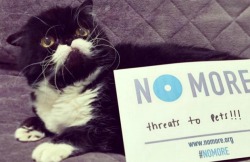
Following is a brief talk given by Vegina at a Take Back that night event…
_____________
Violence against women and the sexual assault of women has touched me in many ways. I am, like so many of you, a survivor and, like some of you, a survivor more than once. I, like many of you, also have friends who are survivors. Too many friends have had this experience.
I have also learned about this issue through my career as a sociologist. I have worked professionally to help torture survivors, and met women from all over the world who have been controlled, demeaned, and abused through sexual abuse. I have also conducted a lot of research involving nonhuman animals and through that work I have learned that the abuse of human women and nonhuman animals is intimately tied.
Animals and sexual assault is likely not a topic you have thought much of, but I would like to tell you a little about it today.
The abuse of women, children and nonhuman animals are often intertwined graphically in cases of domestic and sexual abuse. Abusers often kill or threaten to kill animals, most often companion animals, in order to get victims to comply. One tactic often used by abusers to get children to remain silent about sexual abuse is to tell them that their companion animal will be killed if they reveal the abuse. Threatening animals is also used to keep women in situations of domestic violence. The American Humane Association found that 71% of abused women seeking shelter at a safe house said that their partner had threatened, hurt, or killed their companion animals. Another study found that about half of Ontarian women who had left their abusive partner said that concern for the safety of their companion animals delayed their decision to leave. In the past I worked with an organization called Chandler Edwards that helps nonhuman animals who are sexually abused. I learned through this work that it is more common than many think that women and children may be forced by their abusers to preform sexual acts on their companion animals—a topic that many victims and survivors feel too ashamed to talk about and therefore cannot heal from. In cases where men sexually abuse nonhuman animals they almost always also have a history of abusing women and/or children. Please know, if any of these things have happened to you, you are not alone.
One reason I am speaking about this today is because it reminds us that sexual assault is never simple, it is always complicated. Whether a person decides to report it, leave an abusive situation, the way a person reacts during an assault, and the choices someone makes after are all complicated.
We need to acknowledge this and respond in a number of ways. We need services and support that take these complicated situations into account. For example, many shelters support and accommodate women and children, but what about woman-identified people who don’t fit into traditional female gender categories or people who want to bring their nonhuman animals with them? We also need response services that are aware of these issues. If an animal is found abused we need a police force to be trained to look for abused women and children as well. If a woman or child is abused, we need a responsive police force that will also check on the well being of any companion animals in a household. We need hospitals that are not only equipped with nurses who are trained to do a proper rape kits, but also to address other issues that might be of importance like what insurance will cover, initiating welfare checks on family members a women might be responsible for, and more. Response systems that deal with these complexities are imperative if we want women to survive instead of being victims.
The most import thing that understanding the complexities of abuse remind us of is that we need to remember not to judge the choices a person makes when dealing with, reacting to, or overcoming to an assault or an abusive relationship. Sexual assault is not a moment, outside of the lives of it victims. Victims and survivors are caregivers, family members, professionals, students, community members. Our lives are complicated and our lives touch the lives of others. The decisions we make take all of our roles and relationships into account. We need to remember this and remember not to judge others. Most importantly, we need to remember not to judge ourselves. We have made the decisions we have needed to make to survive. We need to let go of any negative judgment of ourselves and be proud. We are resilient, we are worthy of admiration and respect, we are fighters and we survivors.
it was (not) my fault
[TRIGGER WARNER: For discussion of sexual assault]
This year I accomplished almost all the goals I had set for this decade of my life. I landed a tenure track job at university, I was actively engaged in social justice issues, I was finally financially independent. And sure, it came with some discomfort—I had to leave my friends, my activist campaign, and year-round good weather in a sunny southern California metropolis behind to move to a new, small Midwestern town. But these were sacrifices I always expected to make—I knew there weren’t enough jobs doing what I loved to have the flexibility to choose where I would live. For the most part I had everything I had spent my 20’s working toward.
Here I was, ready for a running start in this new life, and then everything unraveled. It took one bad night and I was reminded how unsafe it is to be a woman and how, as a woman, no matter how hard you work, how much control you think you have, you can never have control. There can always be one night, one man, one incident, which can strip you of who you thought you were. And that is what happened to me.
Below I will tell you my story, but more importantly I want to discuss the themes that surround this story. I hope by articulating them someone else might learn or grow or find solidarity in the experience. I post my story with some reservation. It is long and is not the most important part of this post. I also fear telling my own story will be individualizing what is actually a systemic issue, when so many systemic issues and violences get swept under the rug by positioning them as individual stories alone. But I know context is important, and I know it is important to tell these stories and let the world know they exist. So if you choose to skip my story please do, just scroll through to the next section. If you would like the context of my personal story please continue reading from here.

one bad night
The day the movers delivered all my belongings to my new house, I went out with a colleague to listen to a band at a bar. I stayed after she left to hear the end of the set and that is when the memories stop. Did I drink too much? I had never blacked out before so that seemed improbable, but after some research I learned that in new stressful situations a person can black out even with very little alcohol. Was I drugged? That seemed possible, but I was not unwillingly dragged home by anyone, or dysfunctionally sick the next day. I don’t know how it happened, I just know that about 15 hours of my life were essentially missing to me.
I had flashes of moments that occurred that night, which feel more like flickers of a TV show than they do a memory. I remember talking to a group of people about politics in Israel, I remember one moment of a man helping me walk because I could not quite stand, I remember feeding my rabbits, I remember telling that man I did not want to have sex and him saying okay, I remember making out with that man and being okay with it, I remember telling that man he was getting too close to me and reminding him I did not want to have sex. And that is all. These were the flickers; all strung together it was about one minute recovered from hours of my life. I just had these few flickers and lots of questions. What did he do when I said he was getting too close? Who was he? Why did I not have any memories?
Days later I found the man (or actually, he found me when he stopped by my house to ask me on a date). He stated that we did not have intercourse, he apologized that he did not realize how messed up I was, and even though he swore we didn’t have sex he still agreed to get an HIV test to calm my nerves. Later, a specialist with these cases told me his behavior indicated even if I was drugged, it was not by this guy—that his behavior did not fit the profile.
But at first I did not know any of this. I just woke up with a lot of questions and a lot of confusion so I called a friend and tried to laugh it all off—to call it a hook up. But I could not stick with that story because that is not what it was. I called another friend to ask for help. She admonished me for my bad behavior but she also let me know I could get tests to determine traces of semen and/ or latex. This was great because what I needed most at this moment was to know what happened.
I called Planned Parenthood. They had no openings with a doctor, so they gave me an 800 number that had an automated voice message instruct me to enter my zip code; then they gave me another number to call. I called that number and left a message and a woman called me back. She called the hospital for me and they told me to come in to the emergency room at 4pm (5 hours later) for a SART (Sexual Assault Response Team) exam. So I came in then. I waited in a hospital room for over an hour, close to two, and then it started. They took blood to test for drugs, they preformed an exam to look for tearing (they found none), took swabs to test for semen and latex, and they gave me almost every drug available to prevent or treat almost any known treatable or preventable STI and pregnancy. They didn’t warn me of it, but for a week following this all these drugs left me nearly bedridden as my body struggled to process them.
Then they asked me if I also wanted preventative antiviral medication—drugs to prevent transmission of HIV. The catch? The drugs are very toxic, difficult to be on, and I would be on them for a month. I told them I would take them if they found any evidence of drugs in my blood or latex or semen inside of me.
The other catch? They now told me they would not release that information to me unless I pressed charged against someone.
Now it was about 8pm on a Friday night in a small town where there would at this time be no other doctors available for an exam. I had no desire to press charges—I did not know what happened, I did not know who was with me the night before, and I did not want the state or police involved in my life. So here I was, poked, prodded, examined; all the answers I wanted were in one test tube and on three swabs packed away in a cardboard box sealed with a red sticker that read “EVIDENCE” and I could not access them. They were property of the state.
I decided to take the preventative antiviral medication. I continued to stay on it even after I found the man who confirmed we did not “have sex” and he did not have HIV because, as the infectious disease specialist stressed, I could not actually know what happened, date rape is a very big problem in this community, and HIV does not always show up on tests in the first three months of infection. Plus, this guy could not be that great if he knew I could not stand without his assistance and he still tried to hook up with me—how could I really trust his story? I also decided to take them because every time I tried to stop taking them I got something amounting to an anxiety attack. I would obsessively research HIV and crumble into a dysfunctional mess leading up to the time I had to take the medicine and an even more dysfunctional mess if I did not take them on time. The four weeks before my new job started, when I should have been preparing to teach three classes I had never taught before, editing the journal that needed to go out the door, unpacking my apartment, I was sick. I could not get out of bed easily but I could not sleep well either. The few clear hours a day I had were spent researching issues relating to risk of STI transmission, visiting a therapist and dragging myself to meetings at work. I had reduced control of my body and appetite—I had to force myself to eat meals so I could take the medicine, struggle not to throw up the pills after I took them, and I shit myself twice.
embodying sexism.
A story that begins the way mine does could have been much worse in many ways. And the fact that I am left with a feeling that I am somehow lucky just because this bad situation was not worse, that I somehow feel that this is “not that bad”, is a testament to the problem of sexism and violence toward women in our society. To embody something is to become the physical manifestation of something, to make a concept corporeal. And in the way women come to hate ourselves, blame ourselves, and accuse ourselves when things like this happen, we embody sexism and patriarchy.
From start to finish, it was all my fault. Or at least that is how I felt and how I was made to feel. And this is exactly how sexism works. Women are to blame—from the moment something happens to her through the way she handles its aftermath. And this will happen every time.
“it’s all her fault-she started it.” Patriarchy allows men to be absolved of all culpability and for women to be blamed. Women’s rapes have been blamed on what they are wearing (tight dresses, and even jeans), acting flirtatiously, drinking alcohol, being out at night, not screaming loudly enough while being attacked, and simply for the fact that they showed up to work. And in many cases, while women take the blame, the men who actually assaulted them have gone free.
I was not raped, but the same blame game was played. I was a woman who drank, and who alone. And if I did in fact black out, who drank too much; or if I was drugged, who did not monitor my drink appropriately. My decisions that night might not have been the safest, but only because of the sexist world I live in that makes the world not safe for women. As my friend Renee articulates:
“[A] woman is not anymore at risk than a man from the alcohol- it is men that put her at risk because of their behaviors.”
However, the man who brought me home that night gets a pass for his decision to engage with a woman who was too inebriated (or drugged) to stand up on her own.
At one point (and it took me a lot to work up to it) I reached out to my ex-partner. I trusted him deeply, and at this point in my life he knew me better than anyone else. He listened to me cry and gave me some consolation, but he also reframed my story:
“It’s not that bad. You got drunk and blacked out and made out with a guy who seems like a great guy. He should get a medal for putting up with you and going to get that HIV test.”
This response forgave the man everything (like taking home a woman who could not stand) and celebrated him simply for not raping me when he had the opportunity. It blamed me for everything at the same time—being drunk, having bad feelings about the events, and advocating for my health by having the man get an STI test.
It was this negative feedback I heard most clearly because it validated the more common and dominant sexist and patriarchal response and it aligned with my own self-hatred. I blamed myself that this happened, and then kept blaming myself for how I handled it.
“it’s all her fault- she is handling it all wrong.” I have spoken before about being sexually assaulted. And somehow, I weathered that storm without all the difficulty that I am having now. Something that looked like an assault did not send me in to the turmoil that this has. And at first this brought me shame and embarrassment. Shame that I did not react “more appropriately” the first time by becoming more upset, and embarrassment that I have reacted so strongly and negatively after this experience.
The man who assaulted me in high school was my boyfriend at the time. After I moved away he began to find ways to contact me and for about a decade he contacted me at least annually, declaring I was his one true love or asking for my forgiveness so he could feel absolved. In my late 20’s I told my then-partner about this and how unsettling it was. I was met with a harsh lecture, loudly in a restaurant, about how I should have reported the assault to authorities and because I didn’t I was likely culpable for assaults of other women. This time a close friend lectured me about drinking too much and not staying in control.
And the worst part is that often we just blame ourselves. My former partner was not the first to suggest a woman is to blame if her attacker assaults someone else—an idea that has always and still haunts me to the point I still have anger toward my 17-year-old self. And my friend’s admonishment in this instance for my drinking at a bar alone cannot even begin to approach my own self-rapprochement.
But the truth is that women are not to blame and we should have no judgment of our own reactions. No two of us will ever react the same and no one of us will ever react the same two times. We are people with experiences, and histories, and other stressors and factors in our lives. We are fluid and as women we are forced to respond and react to a violent, sexist system on a regular basis; our responses reflect an accumulation of those experiences that may at times build resilience, other times denial, still other times exhaustion. Our reactions are genuinely us in that moment and they are not “wrong”.
Part of judging my own reaction was an embodiment of a sexist society that has told me that I am the problem, I am to blame, I am shameful. And as much as I can recognize this I cannot shake it. I cannot stop being angry at my own culpability for the situation, the way I reacted, the way I am continuing to manage the aftermath. And I am so used to the violent way women are treated that I feel guilty writing my story because I have placed my experience on a spectrum of the awful things that happen to women, and know it could have ended up worse. As if somehow that means what happened here was not that bad.

a disembodied self
Unlike embodiment, to be disembodied means to be without or separate from one’s body. I was disembodied through this experience as my body became something foreign and no longer mine.
Most obviously, my body was taken from me for the 15 hours that I cannot remember. More insidiously, my body was policed and controlled by the medical, social service, and policing communities. Because I had this experience and because I accepted the state’s help, I was now responsible to show up when asked and show all when told.
i don’t own myself anymore. The medical interventions I underwent further took my body from me and broke me into my parts, taking my story away from me, and making me measurable and digestible so my experience could fit neatly onto forms—pregnancy results, STI results, consent forms, appointment cards. My body was examined, poked, prodded, and tested. But I did not own those pieces of my body, the only parts of me that could tell the story of what happened to me, the story I so desperately needed to know. The state owned them and I had to collude with the state in order to have that story.
The policing of my body quite literally occurred. Was I drugged? Was I raped? I did not get to know unless I worked with the police and actively pressed charges against someone I did not know for something that might not have happened—which I would not do. I did not get to know unless I agreed that state intervention into my life was a viable, safe and healthy option for me—which I did not think it was.
The SART (Sexual Assault Response Team) program I went through was good in many ways. I had a very respectful nurse and a woman from a local organization offered to meet me at the hospital to advocate for me. (I said no to the advocate I spoke to on the phone, thankfully, because I later recognized her name when she was a student in one of my classes). The hospital visit was free and my medicine was covered for the first week. After that it was around $400 a week but a hospital representative helped me get signed up for medical assistance to reduce it to $4 a week, which reduced my overall medical costs stemming from this experience significantly. But in the end, what I was left with from this process was the experience of my body and my life being aggressively medicalized, policed, and taken from me.
After my initial exam I was told to go to an infectious disease specialist. Once there I was warned that now that I was in this process and there were formal records of it, that I must tell all partners for the next six months of my life about this incident (otherwise I could be charged with willful negligence should they get an STI even though I was testing negative for having any). I demanded more accurate and expensive HIV tests than are normally administered, which are accurate at three weeks instead of three months, so that this could all just be over sooner. I received negative STI results, but they still made me come in three months later for testing, noting legal issues if I did not. (I was later told without apology they misspoke about the legal aspect of it, that they had simply not reviewed my case when they said that.) My anxiety over whether to take preventative antiviral medication was pathologized as anxiety but when I conceded to the medical staff that I get off of the preventative antiviral drugs that were making me sick, the doctor suggested I play it safe and stay on them. There was really no winning and nothing I was being told made sense.
At moments I had agency and felt in control, but mostly I just felt controlled. Just as women on billboards and in magazines become pieces of themselves, just symbols of what they represent (sex, props and products), I became symbols of what was happening to me and was no longer a whole person. I was reduced to my vagina, cells on a swab, tubes of blood, an anxious brain. I was just pieces of a person being monitored and moderated.
That there was such an extreme and humiliating response to something that was being (wrongly) framed by so many as “not really a problem” since I wasn’t “really” assaulted, increased my humiliation and disgust toward myself. It sent my whole self into a pit of shame while pieces of my body turned up for appointments, went into evidence lockers, and filled up test tubes.
medicalizion as a tool of oppression. I did not know what happened to me and I took what I thought to be proactive and responsible steps in the aftermath to protect my health. But the way my body was treated and the way my whole self was disregarded actually created a new form of victimization. Nowhere in this process was I allowed to truly advocate for myself or to be empowered. In fact, nowhere in this process did I, as a whole person, matter at all.
The disembodiment and medicalization of disadvantaged people as a way of revoking their power has always been a tool of oppression. In the 18th century Phrenology became a foundation to justify racial violence and exclusion. Saartjie Baartman, the Hottentot Venus, was a racialized curiosity in the 19th century on display for her buttocks and genitals. Female genital mutilation takes pieces of women away from them, in order to try to control them, just as the tradition of foot binding did. Tyra Hunter was left to die by EMS responders at an accident site because she was transgender—her body parts did not match her gender so her entire person was refused medical care. Jews in the holocaust had their bodies used for medical research; black men in Alabama and Guatemalans were used for US syphilis experiments in the early 20th century; and currently billions of nonhuman animals and their body parts are used for experiments. And the list goes on and on and on.
Separating the body from the individual is a symptom and a tool of oppression. That it happens to women who have been assaulted is just another artifact of patriarchy.
support
Almost as soon as this all happened, I asked for support. I had one friend in this new place I was living. She was 70 miles away but came and helped me. For two days she listened to me, talked to me, sat quietly with me, helped me start unpacking, spent hours with me trying to figure out who I was with and what had happened that night, and slept in the bed with me to help me sleep. When she had to leave she told me directly I needed to keep seeking support.
So I asked others for help too. I asked a new friend closer by to listen to my story and she came through. Holding my secret, checking in on me, making sure I was getting through the medicine okay, letting me talk through my feelings.
And my father, a 79-year-old man who I worried could not really relate, became my rock. He advocated for me, used his medical experience to get me the treatments I wanted when he could, sat on the phone as I read through journal articles. He let me be angry or sad or scared or embarrassed—whatever it was I wanted to feel. He let me talk openly about my sex life and this part of my life that others were calling my sex life but to me felt like anything but that. This was one of the first things that I felt I could not tell my mother out of embarrassment (until now if she is reading), but I knew if I did she would be there for me too.
Asking for support empowered me to tell my story to a few people and that support further empowered me to begin to heal. I encourage people who can to always ask for help. But I also know that my ability to ask for help is a privilege. I am an adult who lives alone and supports myself. I am white and middle class and have a stable job and no one depends on me and I don’t depend on the state system or anyone else involved in this situation in my daily life. Speaking out will have no repercussions for me as it does for so many others. I have privilege that most people, particularly women, do not have.

moving forward
I am writing this blog post because four months after this event I still cannot focus and some days, like today, I cannot do the work that I need to get to done. I freeze up and am triggered every time I see the man that took me home that night. (An all too common occurrence in my new small town). I am writing this post to help myself externalize this and make it real in the world. But mostly I am writing this because even though I have an extreme amount of privilege in this world—including the language to discuss what happened, the resources to pay all the medical bills that came from this incident, the social justice background that allows me to know how to advocate for myself, and the social ties to get support and start to heal—I am still unraveled and unhinged by what happened.
I tell my story as a way to join a chorus of voices who have outted themselves as having had these experiences that are never identical and always not completely describable. These stories many of us feel guilty about because we feel maybe part of it was our “fault” or maybe we shouldn’t lay claim to our pain because other women “have it worse”. I am writing this with the hope that in the cacophony of our voices something will happen and we will finally really be heard. We are being oppressed, raped, assaulted, drugged, abused, and more. And no matter what happens—whether it looks clearly like violence or lurks in more ambiguous corners as my story does—we are being shamed and blamed.
Earlier I said that our society makes it unsafe to be a woman. But it is not just women—it is feminine men, trans* people, people who are not able bodied, people who are not heterosexual, people who are other than white, and nonhuman animals. It is downright dangerous to be anyone who can be othered in this society—more dangerous for some then others but dangerous for everyone all the same. And the systems that are there to protect or serve the vulnerable do not do this in a way that we would want.
My story is just one of these stories that happens a million times a day. And it continues because we have institutions and language built up to that allow for these realities to be sugarcoated in the euphemisms of procedures and forms and programs and guidelines and a quick shove under the rug. These things bolster a framework that blames us for these problems when they happen to us and label us fanatics when we speak out about them on behalf of others. These systems never point at themselves, at patriarchy, at the overarching matrix of domination that makes this world unsafe for more than half of us and oppresses most of us.
britches’ day: making our own holidays
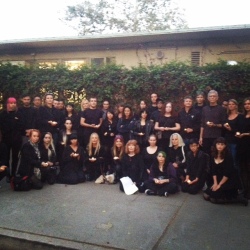
Part of my journey as an activist has been learning to make my own holidays and embracing my friends and fellow activists as family. Sometimes this takes the form of alternative holidays, as I have previously discussed in the case of thanksgiving. Sometimes it means making new holidays.
For me, World Week for Animals in Laboratories is a holiday. The first demonstration I ever organized was for World Week and I have been an activist ever since. This week is a week to reflect and regroup. World Week begins this year with the 29th anniversary of the liberation of Britches, an infant macaque monkey, from a University of California Riverside laboratory. In honor of the day, Progress for Science held a vigil in honor of Britches. We held our vigil in the neighborhood of a woman who experiments on and kills monkeys at the University of California Los Angeles. The ceremony opened with some words, followed by a few minutes of silence. Then the floor was open for people to share. Poems, songs, and letters were shared and together we mourned.
Below are the opening remarks I wrote for the ceremony as well as audio of a poem I wrote and read during the service. I hope that they touch you in some way and you find your own way to act up and get out this week for the animals in labs. Let’s make sure that another 29 years does not pass before vivisection ends.
—
Opening Remarks to a Memorial Service in Honor of Britches.
Los Angeles, CA , April 20, 2014
Thank you all for coming to this memorial service in honor and memory of animals in labs. This service is named in honor of Britches, a macaque monkey who was cruelly tortured at the University of California Riverside in 1985. 29 years ago today, Britches, along with 467 other animals, was rescued by brave human animals who broke the law in order to unlock their cages and take them to safety and freedom.
It is fitting that this year this anniversary falls on Easter. For Christians, Easter celebrates the resurrection of Jesus Christ—this holiday gives Christians hope, reminds them that there is rebirth, and that they can be saved. In a much more tangible way, however, which stretches across race, creed, and religion, Britches the monkey was resurrected, from a place much worse than the still calm of death. Britches was taken from an unspeakable hell. He had been taken from his mother at birth, his eyes crudely sewn shut, a sonar device, emitting terrifying noises strapped to his head—Britches likely had no hope, because he had had no experience less painful than this. He had nothing tangible to hope for. But Britches was saved. He had a personal resurrection from the worst torture, into the loving arms of an adoptive monkey mother.
In the Christian resurrection story Jesus dies at the hands of humans and is resurrected by a divine being. Britches too, suffered at the hands of humans, but no god intervened, it was humans who saved him. We come here today not just to remember those who suffer and those who are lost but to remind ourselves that it is people, including us, who need to fight this injustice.
Today is the beginning of World Week for Animals in Laboratories. It is a week to remind us to reflect on the work we did last year, to take action now, and to regroup the animals’ congregation and army so we can continue fighting and advocating for animals in labs and other human-made atrocities. We must do this until every cage is empty.
We are here tonight in the neighborhood of Edythe London, a UCLA employee, who experiments on monkeys for money. A sea of us, juxtaposed against just one of her. She can cause so much misery but with dedication and persistence we will prevail.
Today we hold a memorial service in honor of Britches. We also hold this service to honor his rescuers and those who continually put their freedom at risk to give others a chance at a life worth living.
But mostly we hold a memorial service today for the millions of other animals who suffered this year at the hands of vivisection. For the rabbits, chinchillas, rats, dogs, cats, ducks, fishes, goats, lizards, cows, hamsters, guinea pigs, nonhuman primates, mice and the many others who are kidnapped from their homes or bred into lives of misery without purpose, while more viable scientific alternatives exist. We are here for the millions of nonhuman animals who suffer as part of a broken system that creates no cures but generates profit for a few.
We are here to take a moment from our fight, to let down those walls we have had to build around our hearts to have the strength necessary to wake up each day amidst such violence and keep fighting and advocating and pushing and pulling and talking and writing and chanting and leafleting and bearing witness. For tonight, we will take a couple bricks from that wall away and will let our hearts truly feel who it is we are here for. We will remember that Britches was less than a fraction of a fraction of a percent. Because he was freed. He was not unique in the torture that he suffered, millions of animals around the word suffer such horrible violence each year. It was in reaching freedom that Brtich’s story was unique. Tonight, our hearts will be open and we will let them beat and ache and bleed for each individual animal who has suffered or is suffering now, whose life has been unvalued by any human but us. Tonight we acknowledge each of them, we open our hearts to them, we remember them, and we mourn.
—
Recording of “To the Animals in Laboratories,” a poem
cops are not friends
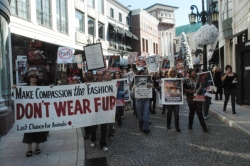
This past Friday was what activists in the US call “Fur Free Friday.” FFF is in response to “Black Friday,” the day after Thanksgiving in which stores have huge sales, making this one of the busiest shopping day of the year. Animal activists traditionally take to the streets and the malls on FFF and speak out against fur.
I have trained my voice to be as loud, and more clear, than a megaphone so that amplified sound laws (or the police’s belief that there are such laws even when there are not) cannot hamper first amendment speech in the course of activism. Given this ability, I often lead chants at rallies, and FFF this year was no exception. In the course of this year’s chanting I gave a monologue, which admittedly steered off course, and made note of the fact that cops suck.
When a store clerk claimed we activists were not “compassionate” I noted that we in fact were. My monologue went something like this (though I can’t remember the exact words, they were similar to those below, and the “asshole cops” part was definitely there, and is the phrase in question…):
“We are compassionate. You are protected from simply our voices by a line of asshole cops, wielding guns. You are protected by a violent police state from only our words. Just imagine how the animals you are profiting off of feel. They are caged, abused, tortured and will eventually have metal prods stuck in their anuses and will be electrocuted; they have no one to protect them from actual violence.”
After the event, the Facebook event page became fertile ground for admonishing me for calling cops assholes. The initial post read:
“Thank you to all the activists who came out today you are all amazing and should be proud[.]
To the lady who gave most of the speeches at all the shops selling fur, I will say you are a great activist and your speeches were great and passionate, but I would please urge you not to call the Police assholes in front of them in the future.
The Police were supportive of us today and they were on our side and calling them assholes will not do yourself or other activists any favours in the future, it makes us look bad and we want them on our side as well as the general public.
You don’t have to like cops if you don’t want to, but I would please urge if you if you see this post not to do that again. Thanks”
Then a conversation ensued in which people debated whether the cops were nice and if I should “apologize.” The conversations continued devolving as the actions of many dedicated activists in the LA area were trash-talked by people who insisted that cops are nice, and aggressive activism is bad.
putting animal abusers at ease
I wonder why the person did not speak to me in person at the event rather than waiting for the platform of Facebook. I wonder why there are so many more characters devoted to the one sentence I said that he did not like than the words that thank me for the other hour and half of work I did that he did like. Would he have ever posted publicly JUST to thank me? Would the part of the post that reads, “Thank you to all the activists who came out today you are all amazing and should be proud” have ever been posted if this person had not wanted to also be negative and admonish another activist’s actions? Probably not.
In the face of so many animals dying for fur, the second largest metropolitan area in the nation holds only one large demonstration all year and has only one year-round anti-fur campaign. Denigrating another activist’s behavior on a public forum, monitored by the police and those who profit from fur sales does nothing more than put animal abusers at ease—selling out our movement as uncollected and ineffective.
(This is also very deflating behavior for the individual activist, and our numbers are too small to turn away hard working activists without good cause. This point I can only make by sharing my personal feelings about this experience. My feelings are not integral to the larger argument so I will not post here, but you can read them here if you are interested…)
Not one time did anyone opposed to my actions contact me personally or even tag me to let me know that my actions were being discussed. In fact, one woman said these comments were okay because I was not “called out.” My actions were discussed for a 173-long comment thread and never once did anyone ask me why I made the comment I did. I wasn’t asked, but I will explain…
the cops are not our friends
Whoever out there really believes that the cops are on activists’ side, that they are potential allies, or that it is okay to talk to them, PLEASE WAKE UP. The cops are not our friends and they were not at FFF for our protection. As one commenter on Facebook, Shannen Maas, aptly noted in response to someone suggesting the cops are there for the protesters’ sake:
“The [the cops] stand between us and the businesses. They face us and are ready to attack and arrest us in [sic] something goes awry. Make no mistake of why police monitor protests, it’s to make sure that we can’t be a single ounce more effective than they would like us to be.”
normalizing state violence
That so many activists supported the police in this thread highlights how routine and accepted the visible displays of power and violence exhibited by the state have become. LA police officers need only a GED as an educational requirement. The city’s standards are not high but the power they give the police is immense. The police have guns and billy clubs with them as well as less obviously deadly weapons such as pepper spray and restraint devices. They openly carry visible reminders that they are in charge and can hurt or kill us at will.
That unarmed activists who were using only their voices were being followed by people with weapons is a despicable display of the state’s abuse of power. That activists are not enraged by this, and even go so far as to defend these people (who they do not know and who are clearly less aligned with them than other animal rights activists are) as “nice” people who “deserve an apology,” highlights just how normal this harassment is and just how co-opted by the police state US citizens are.

accountability denied
Trite comments that had no relevance to the situation at hand were being brandished in this thread—highlighting a learned tendency among people to assume cops are okay and there for protection. It also reflects an unrecognized tendency not to hold certain people accountable for their actions. For example, there was the comment that calling cops assholes was bad because it would turn off the public. However, anyone there would have been hard-pressed to find much public—it was a rare rainy day in LA and even though this day is typically a busy shopping day there were almost no shoppers that day. Someone suggested to me that what those comments were leaning toward was that the cops were bystanders and potential allies. My response to that is, and let me be clear:
Cops are not our allies. They are paid to oppress activism.
Some people on the thread tried to let cops off the hook. One had the observation that “the police are our brothers and sisters and mothers and fathers…” as if that statement absolves them of accountability for what they are doing. I am related to a cop, a former vivisector, and lots of meat eaters. Just because I am related to them does not absolve them of any ounce of accountability they hold for what they have done to destroy others’ lives. Rapists, murderers, and animal abusers are all someone’s “brothers and sisters and mothers and fathers.” And guess what, so are the activists who are being dismissed in favor of the cops. If this unproductive analogy is applied to anyone it should be people who live lives in line with one’s own morals, not strangers with weapons.
Another sentiment expressed as to why activists should actively seek to be nice to the police is that cops are just doing their jobs. Yes. EXACTLY. Their job is to oppress and restrict activism, which is exactly why they should be held accountable for their actions. And as much as they are “doing their job” when they follow activists around, in the case that an activist slips up and can be arrested, they are choosing not to engage in other police work. There are plenty of undercover videos of slaughter facilities in Los Angeles and damning reports that show the city’s main university, UCLA, regularly violates lab animal welfare violations. The police know that they can walk into one of these facilities at any time and they will find people breaking the law and abusing animals. However, the cops never decide to police animal abusers who ARE breaking the law; instead they police law-abiding activists.
cops heart corporations, not activists
Some activists on the thread believed the cops were there to protect protesters. The delusion that would lead anyone to that conclusion is beyond my comprehension. As was stated by another activist—they face activists, not the stores. They are ready to attack. People on the post misconstrued the act of police briefly stopping traffic to allow activists to cross the street as an act of kindness. The police were interested in keeping protesters together so that we would be easier to monitor and manage; allowing us to be split up at stop lights would have caused them to choose to leave some store fronts un‘manned’ or some activists unwatched. Ego makes us want to believe others agree with us and want to support us. But they generally don’t when it comes to animal abuse. The cops are paid to subdue activism—their uniforms are made up of leather, they probably eat meat and always will. I promise, they are not concerned about helping activists, much less the cause of FFF.
calling cops assholes may be bad, but only because cops are, in fact, assholes
I did make a mistake in my words. Pissing off cops by calling them assholes when so many activists could be at the receiving end of their violence was not a smart or safe idea on my part. Because cops are assholes, they are likely to react poorly if their feelings are hurt, even if it is legally protected first amendment speech.
My mistake was putting activists in greater risk of state violence, not in hurting a cop’s feelings or being rude. Animal activists tend to be white, female, and well-educated. We are the type of people who are the least likely to be abused by the police. Our privileged position suggests it is actually a duty to stand up to cops. We most certainly should never defend them. However, we should speak out against them and to them when we are alone, rather than in a group of other activists who could bear the brunt of police violence. So, I apologize to all the activists there for my behavior, as it may have put you at risk.
But these are not the reasons people were upset on this thread. Sadly, one activist on the thread equated calling cops assholes with threatening their lives. This sort of hyperbole is borrowed from animal exploiters and used too comfortably and too often among activists. She then lamented she had been arrested because of activists mouthing off to cops. The take home lesson for her was that an activist such as myself who angrily reacts to a cop is “some idiot…who decides that protesting for the animals isnt [sic] important” and is just doing it to “earn street cred.” Rather than blaming the cops, who illegally violated her right to free speech by physically restraining and imprisoning her, she decided that the activist was in the wrong. This tendency to cannibalize our compatriots is exactly what the opposition wants. It keeps up impotent and ineffective. It is a panopticon of self-regulation in proportions not even Bentham or Foucault could have dreamed up.
repeat after me. the cops are not our friends
The US government, with the military and police sent to do their bidding, regularly engages in egregious human rights abuses. This includes the brutal murders of innocent people, as has been highlighted by recent drone attacks which have killed hundreds of innocent people in the past few years, to torture such as the vicious holding of over 150 prisoners in Guantanamo for over a decade without even filing charges and leaving inmates in solitary confinement for upwards of 20 years in US prisons.

Domestically, police are also a major cause of killings:
“Since 9/11, and the subsequent militarization of the police by the Department of Homeland Security, about 5,000 Americans have been killed by US police officers. The civilian death rate is nearly equal to the number of US soldiers killed in Iraq. In fact, you are 8 times more likely to be killed by a police officer than by a terrorist.”
That means that, on average, cops in the US are killing at least one person every single day. Compare to Iceland, where only one person has been killed by the police, ever; and though it was an egregious situation and the cops had little choice they apologized and lamented their actions. Conversely, in the US cops try to get a pass and are defended by the state when they murder; even though their killings and other abusive behaviors such as stop-and-frisk and political repression reflect a clear pattern of discriminatory application and overuse of their power.
The US has the highest incarceration rate in the world and these incarceration rates reveal systematic and selective policing and punishment. Black and Latino men have incarceration rates six and three times higher than white men, respectively. A study by the American Civil Liberties Union revealed that 3,278 people in the US are currently serving life sentences for nonviolent offenses and about two-thirds of these people are black. Incarceration rates not only reflect, but also create, racial and ethnic inequality in our society.
Just as discriminatory policing creates racism, it assists in political repression through selective and aggressive policing of activists. In fact, every time the animal rights movement makes strides, the state steps in to shut it down. And it is the FBI and police who are in charge of this abuse. This leads to situations in which the targeting and repression of activists simultaneously becomes an excuse not to go to protests (fear of cops) at the same time that it encourages activists to seek approval from cops (and even leads some to believe that arrested activists actually did something wrong).
It has created a situation in which those who do go to protests make statements like this: “…[I]t is always important at any protest or march to have the Police on our side and show them we are the good guys.” In this thread it clearly led to a situation in which it became so important to get a thumbs up from police that activists actually got angry with an ally for openly taking a rhetorical stance against state violence.
cops are bad for activism. period.
If the police at FFF were in fact being “nice” is it only because the demo only happens one time per year and seems ineffective. Any time an effective protest campaign springs up in LA the LAPD makes sure that the cop to activist ratio is about 1:1 and many legal 1st amendment activities are prevented as a matter of course—just take the 2007 Los Angeles May Day Protest or the Occupy sweep.
Members of the police and FBI engage in everything from small-scale harassment to active systematic attempts at silencing animal activists. In one recent example (of many possibilities), an LA area activist who captured undercover video of animal abuse at a slaughterhouse was detained by cops and is being charged herself with animal abuse in retaliation for her whistle-blowing activity. State authorities are not our friends, and arguing on Facebook about how nice they can be and genuinely being angry with another activist for calling a cop an asshole is a seriously misguided use of passion.
At the same time that activists use police harassment as an excuse not to engage in regular sustained protest activity (e.g. “I don’t want to be arrested” “I don’t want to be on ‘the list’”), they claim police can be nice, and are “just doing their job.” I call bullshit. Cops are absolutely not our friends. Their job is to shut us down. The most dangerous thing to a corrupt state is free speech, good ideas, and the work of activists. Our country’s greatness is that its citizens are free. We are allowed to call the cops assholes if we want to. But as free as we technically are, business interests and the interests of the government (which is controlled by big business) will always be to shut down the ideas that will cost them money. Businesses use animals—they take their bodies for free and sell them for a profit. Our freedom might be ours on paper, but make no mistake, it must be fought for and the police will try to take it away. The cops are never on our side, and if you think they are then you have bought in to a police state as norm, and you are playing by the rules of the oppressor.
the forty five million
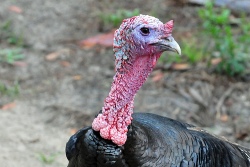
Thanksgiving day has been integral in my development as a person. As I described in a previous post, a televised game of bowling, using frozen turkeys in lieu of bowling balls, was a catalyst to my decision not to eat turkey. It took over a decade before I became vegan but I got there. Later, I learned the racist roots of the holiday; a story much different than the one I had been taught as a child. Learning of this lie allowed me to begin questioning authority and the status quo. If my teachers and parents could lie to me, it was up to me to investigate important issues and make my own decisions. It pushed me on a path of advocacy for other humans and has led me to a working professionally in human rights.
Four years ago, on thanksgiving, I wrote my first post on this blog. Three years ago I began fasting during the day. Last year I fomented my own tradition along with fellow activists. Along with fasting we drop a banner that provides a URL where people can learn more about the holiday. Below is a video of my friends engaging in this activity last year, along with the text from website I created to help educate others about this day.
Whatever you are doing today, I hope you are thinking of all those who have been oppressed by the racism or speciesism. And whatever you do, however you spend the day, do not eat anyone. And do not sit silently by as others do.
—–
The first thanksgiving feast was in the early 1600’s at Plymouth Plantation in Massachusetts. After a harsh winter European settlers lost around half of their population. Those who survived did so because the Indigenous people in the area (a.k.a Native Americans) taught them how to farm. This first Thanksgiving was a celebration of the first successful harvest of the season for the European settlers. Thanksgiving has now become a time to gather with family, watch football, eat a lot, and relax. Today brings back fond memories of childhood for many of us, as we use the day to teach our own children family traditions and virtues of thankfulness. Though the day symbolizes positive things to many people, it is important to look at the roots of the holiday and to think deeply about the way we are celebrating.
human genocide.
After such generosity and a show of community, European settlers destroyed Indigenous populations. Indigenous people were systematically murdered, raped, enslaved, and forced off of the land where they lived. It started on the east coast with the original settlements like Plymouth Plantation, and it continued west as European settlers followed a dream of Manifest Destiny. The destruction of Indigenous populations has continued throughout U.S. history. A partial list of atrocities include: Conestoga Massacre, Gnadenhutten Massacre, Sand Creek Massacre, Camp Grant Massacre, Wounded Knee Massacre, Trail of Tears, The Reservation system, “The Reservation schools,” 1830 Indian Removal Act, Cointelpro infiltration of Red Power Movement.

Wounded Knee 1890
European settlers, who later became the white land-holding citizens that established the U.S. political and legal systems, were spared by the generosity of Indigenous peoples. However, their returned the favor with colonization and the genocide of native populations, ways of life, and cultures. Today, Native Americans suffer inequalities in health, income, and education because the U.S. government continues to discriminate against them.
animal genocide.
Thanksgiving is typically celebrated with a huge feast. The center of this feast is most often a turkey. An estimated forty five million turkeys are slaughtered for thanksgiving day in the United States alone each year. That is equivalent to the number of individual Skittles in 750,000 bags of Skittles.
Turkeys feel pain, have a desire to be free, and want to live for something other than to be killed for our consumption. In this way they are no different from humans or the cats and dogs that might live with you at home.
Almost every single one of the 45 MILLION turkeys who are killed for thanksgiving dinners endure the following:
- They are typically housed in crowded conditions with thousands of other turkeys, barely able to move
- Their toes and the tips of beaks are cut off without any pain medication
- Due to selective breeding, they grow so large at such a fast pace that their skeletons can’t support them and they have trouble standing
- Being hung by their feet, fully conscious, on a suspended moving rail that will take them to slaughter. The slaughter line moves so fast and corporations cut so many corners to save money, that many turkeys are fully conscious and alive when they are plunged into boiling water to be defeathered.
There is no need to buy turkeys and further support the factory farms when there are plenty of delicious meat-free proteins available to eat.
Here is turkey slaughterhouse:
think twice.
Please think twice about why you celebrate thanksgiving and if it is even worth celebrating at all. The racist roots embedded in the day’s history are still alive today, and they can teach us a lot if we take the time to think things through. Racism remains prevalent in our culture and public policy continues to disadvantage racial and ethnic minorities. The U.S. government also continues to colonize other people and wage war on other cultures and nations.
Mass media has been terribly effective in teaching us that we can embody the proverbial American Dream by upholding senseless, truth-censoring traditions.
Although many of us cherish our non-human animal companions at home, we experience some sort of disconnect when it comes to the animals we eat. But just like your animals at home, turkeys feel pain, experience fear, and want freedom. Just like you, turkeys feel pain, experience fear, and want freedom.
Once we recognize the economic forces driving the massive commercialization of the Thanksgiving holiday we become better able to understand why the historical censorship is so heavy. Once we accept that “Thanksgiving” celebrates the massacre of Indigenous peoples, such an occasion is both marginalizing and absurd.
Please redefine the occasion for yourself and extend compassion to victims of slavery and slaughter. You do not need to eat turkeys; they were once living with their own dreams of happiness and freedom. In fact, you do not need the holiday at all to give thanks or to spend quality time with those you cherish. Knowledge is power, and living intentionally while applying new knowledge to your lifestyles is one of the most powerful things you can do.
liberation, not procreation
Even within the vegan and animal liberation communities, principles surrounding family and fertility are not held consistently across species. To remain ideologically and, more importantly, ethically consistent, those who promote total liberation for all animals should not bear children. This can be accomplished either by remaining child free or by choosing to foster or adopt already-born children. The key arguments for childbearing as a valued step in the process of childrearing replicates several ethical and ideological imperatives against which animal liberation advocates argue. It supports biological arguments of superiority, creates unjustified boundaries to delineate hierarchies, values humans over other animals and the Earth, values humans with capital resources over humans in poverty, and neglects the needs of those children who are without families.
naming natalism
(Pro)natalism is a belief that promotes having children. This ideology is dominant and rarely questioned in most cultures. It is also rarely called out and referred to by name (when is the last time you heard a parent described him/herself as a pronatalist?). However, that which goes unnamed goes unquestioned. Feminist theorists such as Michael Kimmel have identified this trend in the maintenance of gender and race hierarchies—for example “man” refers to a white straight man and we know this because any other type of man must be labeled with a pronoun (black man, gay man, poor man, etc.). Melanie Joy has identified this in the case of maintaining meat-eating as a norm as well (she suggests calling meat-eaters “carnists” while I prefer Steve Best and Paul Watson’s term: necrovore). Similarly, I am suggesting we label the pronatalist position. How we do this productively is a topic for another essay as it opens up many new doors (e.g. is “breeders” simply a pejorative term that plays of sepeciesist ideology or is it an accurate label? Is “pronatalist” too esoteric to be effective? Etc.).
The point remains though that it is important to label the pronatalist position so that the pro-child lifestyle is seen as a lifestyle choice, not an expected stage in the life cycle. There is simultaneously a desperate need to normalize the child-free position as a viable and commendable option for those who have the privilege to make choices over their fertility.
overpopulation
Via agricultural and medical developments humans have done a wonderful job raising our population. However, the rate at which this is currently occurring is unsustainable. In 1650 there were about a half billion people in the world. In 1830 there were about a billion. That means it took almost 200 for the population to grow by a half billion people. The next billion people only took 100 years—in 1930 there were two billion people. By the end of the 20th century, just 70 years later the population had more than tripled to about six billion people. As we headed into the 21st century, it took only 12 years for the population to grow from six to seven billion people. There are now over seven billion people on this planet producing waste, urbanizing natural lands, growing food in an unsustainable manner, eating millions of animals daily, and destroying the Earth in other measurable and immeasurable ways.

A typical retort to arguments against reproduction that are concerned with overpopulation is that, in many western nations, overpopulation is not a problem. However, the problem of human overpopulation needs to be handled on a human level, not a national level. Nations are lands with constructed borders. Honoring those borders over the wellbeing of living others is a travesty and not a viable argument for procreation from a liberatory perspective.
People are people are people so while, in the US, the fertility rate (average number of births per woman) is 1.9, in Niger it is 7.1. When animal liberationists argue for spaying and neutering they do not consider some dogs or cats to have more of a “right” to breed than other dogs or cats. We don’t say feral cats have more pregnancies than house-cats so house cats shouldn’t be spayed. Instead, the entire species is viewed as at-risk and the idea that one cat would be left on the streets or killed in a shelter so another could be bred is unthinkable.
Overpopulation not only degrades the Earth, it takes needed land away from nonhuman animals. As the human population grows, the extinction of other animals and plants speeds up. Urban sprawl, introduction of non-native species, food preferences, and pollution all lead to the death of other animals, and at a rate leading to extinction for some. There are currently about 400 endangered species in the U.S. alone. Further, the proliferation of the human population means that more animals bred exclusively to be killed for their meat, skins, or other utilitarian anthropocentric purposes.
Human overpopulation also leads to an increase in inequalities among humans. As there are more people sharing fewer resources exploitation and the affirmation and solidification of current hierarchies of power and wealth are strengthened. More affluent countries have lower populations, less poverty, and more space for people. They accomplish this via the exploitation of other people and lands. For it is the privilege we have in the US that leads to the problems of poverty and a lack of reproductive health and control in some of the nations with the highest populations.

We allow others to remain impoverished, under-educated, and without access to adequate education (including about reproductive health and control) in order to feed our desire for inexpensive consumptive goods, all foods being available year round, and other luxuries. The cost of human overpopulation is a global crisis from an environmental perspective, a human rights perspective, and because there are abandoned and orphaned children who desperately need homes. Privilege is built on the disadvantage of others so we must act on our privilege responsibly. We may not be able to stop the daily onslaught of human murders that our government commits in other nations via military occupation, drone attacks, and other violence, but we can live more humbly, less selfishly, and more responsibly. Not procreating is one of many things we must do to achieve this objective.
biological borders
Boundary construction goes beyond the aforementioned assertion of nation-state boundaries. Biological borders are asserted as well in pronatalist reasoning and the very same arguments animal liberationists argue against, such as biological superiority, are called upon to justify childbearing. These arguments rest their laurels on the same logics as arguments for eugenics, phrenology, and racism.
There are a number of arguments for having a biologically related child. One is that it is the natural urge of humans to procreate. I am not a biologist so I will not attempt to refute that, and I actually believe it to be true. However, the fact that we can do it or even that we are driven to do it does not make it right. Animal liberationists accept that desire alone is not an adequate ethical criteria for meat-eating, fur wearing, and using animals for entertainment; it should not be a justification for childbearing either. I have had myriad debates with people over whether our teeth are designed to eat meat. Debate as I might, in the end, I just don’t care. It is not okay to kill others for food when there are other options—no matter what our teeth look like—as we have the ability and privilege to make other choices. Biological arguments have been made for everything from the desire to rape to genocide. It doesn’t matter if there is an ounce of truth to any of it. It is simply not right and should be rejected. Humans must reject childbearing as well. Even if it is what we want to do it will lead to our extinction, and has already lead to the extinction an suffering of so many other animals.
Some advocate one-child families or one-child per person as a “replacement rate.” I, however, advocate no child or adopted-child families for those who have the privilege to choose. The one-child solution is easier to promote as it does satisfy another argument that I hear often that people should have one of their “own” children (even if they do adopt another child). Either because it just feels different, there is a desire to experience pregnancy, or to keep one’s genes in the gene pool.
The idea that we need to have our “own” babies, even while we assert control over the reproduction of other species is an anthropocentric position that is logically inconsistent with the claim that human and nonhuman animals deserve equal amounts of consideration. That inconsistency only exists because individuals interested in equality are still willing to reproduce hierarchies and inequalities insofar as they are the beneficiaries. As animal liberationists we must reject such arguments in favor of libratory politics that are inclusive of everyone’s needs. The Earth and human and nonhuman animals will all collectively benefit from a cessation of the current boom in human population and human dominion of the Earth.
This assertion of biological superiority is exactly what animal liberationists reject in arguments that pit the human species over other species. It is the same logic on which racism rests, it is the logical impetus behind eugenics. These arguments always assert a superiority, which can later become the justification for the oppression of others. It is inconsistent with a liberatory politics that rejects racism or sexism or other –isms built on very minor biological differences.
If you randomly selected any two fruit flies and compared their DNA, then randomly selected a human and a chimpanzee, there is likely to be more genetic variation between the fruitflies than the human and chimpanzee. Given biological realities such as this there is little reason for any person to assume his or her genes are so superior from another person that s/he will produce a “better” person. Notably, this “gene pool” argument, extended to its logical conclusion, would also suggest that anyone with any mental or physical deficits or any other trait not culturally valued should not procreate. And this would include most humans. So, while I reject the gene pool argument, it also pushes for humans to stop procreating.
This sort of biological boundary building is also what maintains species hierarchies. As animal liberationists work to shift the line of who “matters” to include all animals, we should not at the same time construct and promote intra-human biological borders. For this reason a particularly problematic argument for procreating from an animal liberation perspective is the argument that vegans must have babies because they are naturally more compassionate and they need to spread these genes. There is no room for vegan exceptionalism when pushing for equal consideration.
accepting privilege responsibly
“Privilege” is a word I have used a lot in this essay. I want to be clear— I am not advocating for these principles to be applied to all people everywhere. This is an argument relative to those with privilege—the privilege of education about reproductive health and the privilege of access to fertility control methods. We have the privilege of choice. We must use that wisely and advocate for that privilege for everyone.
I also do not advocate for policies to enforce or control the fertility of others as policies are instituted by nation states with the interest of only the elite in mind. For that reason policies surrounding fertility control and sexual health have historically been racist, sexist and classist—the Tuskegee Experiments in the early 1900’s, involuntary sterilization of women in Chicago in the 1970’s, the use of Norplant as a requirement of Parole release since the 1990’s, and the list goes on.
Policies about fertility and birth control will be racist and sexist and discriminatory in myriad ways because our notions of family and the pronatalist ideology in itself is entrenched with discriminatory politics. Having children becomes the lynchpin of various arguments for and against the full social incorporation of disadvantage groups. Poor and non-white mothers are lambasted for childbearing the wrong way (racist stereotype: group x, y, or z has too many (or any) children outside of “ideal” relationships…e.g. “welfare queen, breeders, etc.). And while this argument is rooted in stereotype it goes a long way to engender bias and discrimination. Even socially, people often feel the need to make note when Black or Latina women with children are married, as if that somehow justifies her worth. And these ideologies become fomented institutionally as well.
This culture’s pronatalist assumption has also led to the idea that having children is part of the debate over the legitimacy of homosexual couples, implying that these unions might not be valid otherwise. Many arguments for gay marriage are premised on arguments that homosexual couples can be just as productive as heterosexual couples by having and/ or raising kids. Arguments over the desire and ability to raise children are seen as the justification for the physical, emotional, and financial union between two people and the issue of equality and choice often remains underemphasized.
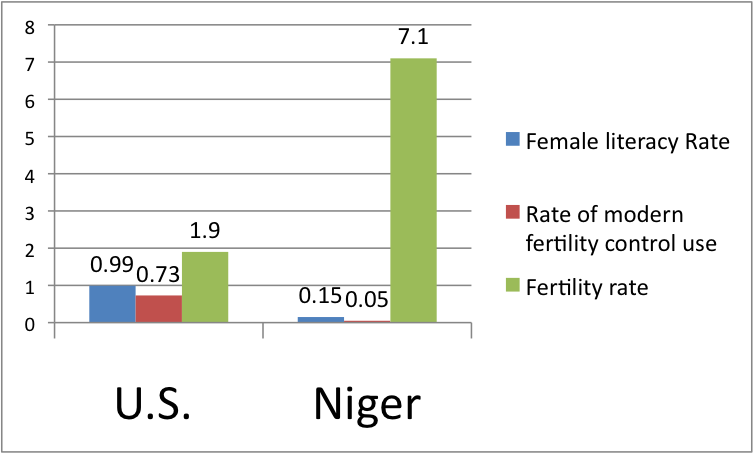
The answer is more education and the empowerment of women, not more policy instituted by the privileged. The countries that allow women the most education and the most access to fertility control are the countries with the lowest teen pregnancy and fertility rates. Let’s return to the US/ Niger comparison. In the US, 73% of women aged 15-49 use modern birth control methods, while in Niger only 5% of women use modern birth control methods. Notably, the literacy rate of women in the US is 99%, while in Niger it is only 15% for women. These literacy rates also highlight variable gender inequality as well, for in the US men and women have the same literacy rate while in Niger men have a literacy rate of 43%, more than twice that of women.
(FYI, I am not insinuating the US gives enough rights over reproduction… The Bush-era bans on comprehensive sex education and current assault on access to prophylactics in schools and to abortion services leave the US falling behind other Western countries—but way ahead of many nations—in terms of women’s reproductive rights).
there are other options
One great option is not having children—and not being ashamed of it. Generally, the option to remain child-free is not socially supported and when it is it tends to remain relegated to a sub-cultural space, exclusive to the child-free and functioning more as support groups or places of affirmation, rather than spaces where the intentionally childless can just exist. For example, a number of female authors and bloggers write on the topic, seeking to assert their worth outside of their womb. Some hetero-sexual couples celebrate being DINKs (dual income, no kids), bragging about luxuries such as late night social events and traveling that free time and extra money allow. And others consider themselves GINKs (green inclinations – no kids), promoting their child-free choice as an environmental responsibility. While these spaces may comfort the frontrunners of the child-free lifestyle, they highlight the way in which this a niche choice and how choosing not to have children becomes a defining characteristic of a person. A reconceptualization of social responsibility and family, particularly within libeartory politics, is desperately needed.
adopt. don’t shop.
Another option, which rejects child bearing but accepts childrearing is to foster or adopt children. This accommodates those who retain the idea that child-rearing is an important part of a fulfilled life. This option is also laudable, and may even be viewed as a responsibility for those with the appropriate emotional, temporal, and material resources, as it not only avoids childbearing but actually helps to ameliorate the social problem of children without permanent homes. There are currently 130,000 children in U.S. foster care facilities alone waiting for homes and an estimated 20,000 young adults age out of the system each year without being adopted.
Animal activists routinely make the argument that adoption of nonhuman animals is crucial for preventing the deaths of shelter animals. To hold this opinion in the cases of nonhuman animals but not in the case of human animals is ideologically inconsistent. A popular slogan among animal liberation activists is “Every dog bred is a shelter dog dead.” This translates to human animals as well. Put another way, every child born is an orphaned child neglected. And this neglect has a tangible negative impact on those individuals and on society at large. Children who grow up in state facilities are less likely to get jobs and when they do have lower earnings, may have higher arrest rates, higher teen pregnancy rates, and more difficulty maintaining healthy spousal relationships. There is a need for childrearing but not childbearing.

From this perspective the use of In vitro fertilization (IVF) and other fertility promoting methods is particularly vile and inappropriate. To lack the ability to bear a child and still choose to create new life over protecting and promoting those who are already alive and in need of homes is a travesty. Further, the culture surrounding IVF and other techniques reinforces various status hierarchies and inequalities that animal liberation activists should adamantly reject. Only those with money can afford them and typically those who need money become donors and surrogates. Further, the idea that at least one (and sometimes two) parent(s) must be biologically related is often the driving force behind such procedures; again asserting biological boundary building.
Importantly, there is institutional and cultural baggage that needs to be unpacked to make this option more viable for more people. First, the process to adopt children is often cumbersome and expensive and not everyone who is fit to raise a child is granted the legal right to adopt. And some not fit to raise children but with the appropriate funds can adopt nonetheless. However, this should not be an excuse to procreate. Institutional shifts should be demanded and promoted rather than simply using them as an excuse.
Animal liberationists would never suggest to someone who lives in an area where vegan options are limited to wait until it is easy to be vegan to stop eating animals. Likewise, we cannot wait until adoption is effortless to promote the cessation of childbearing among those with the privilege to make such choices. In the short term that may mean people who want children don’t get them, but that is a necessary sacrifice and those people must think outside of the box and add productively to children’s lives in other ways (e.g. fostering, teaching, mentoring, etc.).
Second, there is an imbalance between the number of white people who want to adopt and the number of children of color up for adoption. Currently most adopters (73%) are white though only 40% of children up for adoption are white. White people need to be willing to adopt nonwhite children and so a lot of racism needs to be unpacked on a cultural level to allow more multi-ethnic adoptions. In the meantime, animal liberationists should avoid playing into the system that privileges childbearing and shifts in adoption policy should be pursued—we can be some of the first to promote and fight for such adoptions.
your children will be murderers
Bottom line, there are already enough children in the world. There is no need to create more. Humans are the problem. There is no way for humans to reduce their negative impact to zero or to add so much benefit they cancel out the damage they do. Adding any single body to the overpopulated human species is a disservice. Adopting or fostering and intervening in the life of someone who would not otherwise have been exposed to a compassionate and vegan household is doing something good. Adding another human is not.
Even if you do everything right, your child will be a part of the problem. From the moment that the baby shower is thrown a child becomes a consumer. According to the EPA (Environmental Protection Agency), there are over 7.6 billion tons of disposable diapers discarded each year in US landfills alone. (As a side note, every parent-to-be I know who swore s/he would use cloth diapers, didn’t). Add to that all the paper towels, excessive clothing, products purchased for short term use, social funds funneled to children whose parents need financial assistance, and the list goes on.
Further, there is no guarantee you are raising a vegan human. Having vegan parents does not necessarily a vegan make. Animal liberationists should understand this well as so many of us have chosen life paths totally at odds with anything our own parents envisioned for us.
Even if the parent-child relationship is perfect and there is no meat-eating-for-the-sake-of-rebellion there will be sleepovers, school trips, and extended-family outings that will lead to meat-eating, dairy-consumption, trips to zoos and circuses, and any other number of abusive situations.
Why not raise a child who was already on this planet and likely going to eat meat with gusto and introduce her/him to a compassionate vegan lifestyle rather than create a new life? Why not privilege raising a child who was already on this planet and who needs you?
an afterthought: ideological extensions
This debate is not a simple one. Along with these issues come a variety of other questions about inequalities, relationships between human and nonhuman animals and questions about what “animal liberation” will ultimately mean for these relationships. I will not broach these topics in this essay but wish to leave you with this thought so that we might develop on it and grow with it moving forward:
Recognizing speciesism in fertility control also forces a critical look at the methods used to control fertility and calls into question the way that we assert fertility control over nonhuman animals. When seeking to change the reproduction of male companion and farm animals we castrate them, removing their genitals. This has the benefit for humans of also changing their behavior, because as their interest in sex declines and they become more docile household companions. Animal liberationists need to critically investigate the human-animal relationship and be willing to reinvestigate how we deal with the overpopulation of other animals, particularly if we are able to provide them more space and autonomy by getting our own population under control.
liberate your language
If you missed my last guest blog on Viva La Vegan, here it is!
————
Through slang terms, idioms, insults, and standardized grammatical constructs, language reflects current social inequalities. It is packed with the vestiges of a culture’s history of domination, exploitation, and discrimination. In this way, language not only reflects inequality but also has the potential to oppress. In using problematic language, we reinscribe abuses and inequalities. However, by simply not using such language, we can free our own words of exploitation, forcing others to confront these issues when they hear us speak.
In this post I will focus on how language oppresses (and how we can liberate that language) as it applies to nonhuman animals and speciesist ideology. Importantly though, as I will describe below, it is impossible to discuss speciesist language without also discussing racist and sexist language, as they are all interlinked by a prevailing structure of inequality that operates within most institutions, belief systems, governments, and cultures globally.
Language oppresses in various ways. In relation to animals, the most notable ways that language reinforces and solidifies inequality is through pronouns, the use of “mass terms,” inaccurate language, derogatory terms/insults, and culturally specific idioms and adages.
pronouns. One of the most obvious ways that the English language oppresses is through the de-sexing and objectification of animals with pronouns. Many of you have seen the wonderful advertisements to promote veganism, which show an image of a “farm animal” with copy that reads: “Someone not something.” This distinction between subject (someone) and object (something) is extremely important for changing the way that people think of nonhuman animals. It is in the objectification of other animals that we deny them sentience and personhood so that we may use their bodies for sport, transportation, entertainment, clothing, food, work, or whatever else we humans please.

This transformation of other animals from subject to object, happens quietly through the use of pronouns. Animals are “it,” not “he” or “she;” they are “that” and “which,” not “who” or “whom.” Rendering an animal sexless, classifying him or her as “it that” rather than “s/he who” takes away a crucial aspect of the way in which the English language identifies (human) subjects.
Making the shift to “s/he” rather than “it” is simple but very powerful. If you don’t know someone’s gender, just do what authors do when talking abstractly about humans—switch back and forth between he and she. Never use “that” or “which,” always use “who” or “whom.” This is a very easy thing to do in your speaking and writing and for many animal advocates it will likely feel good and become natural rather quickly. More important than its being easy, it will be noticed. Sentences will just feel “off” to listeners, as this is technically not “correct.” Your spell-check will try to correct you and if you write professionally your editors will, too. But as you persist in speaking accurately about nonhuman animals, people will notice and be forced to confront the issue in their own thinking.
mass terms. This objectification of other animals via language also occurs through what Carol J. Adams identifies as “false mass terms.” This phrase refers to the lumping together of many individuals into one undifferentiated group (“mass terms”), thereby erasing individuality and establishing an inaccurate (“false”) sense that all in the group are one in the same. One way to think of it is as an extreme stereotype or profiling.
As Adams explains in her article A War on Compassion: “Mass terms refer to things like water or colors; no matter how much of it there is or what type of container it is in, water is still water…Objects referred to by mass terms have no individuality, no uniqueness, no specificity, no particularity.” This is a problem, because, “…humans make someone who is a unique being and therefore not the appropriate referent of a mass term into something that is the appropriate referent of a mass term” (emphasis added).
The way this works in regard to animals is through the identification of classes of animals and species of animals as if it stands in for any individual animal, and such that any individual animal stands in for the whole group. For example, by making someone a “farm animal” we classify her as a type of animal that can be killed for food. Further we often identify animals by species, as if all in that species are the same. This also allows for us to abuse animals en masse for the purposes of food and clothing. It also allows for policies to be set in place that are not in the best interests of some animals. If any cheetah is one in the same as the next cheetah, then trapping and caging some of them for “education” or conservation efforts in zoos becomes acceptable. If each cheetah matters, though, kidnapping any cheetah would be (rightfully) unacceptable.
We use false mass terms when we rely on inaccurate binaries as well. The most prevalent and harmful is human/animal. This is an us/them construct, which establishes a hierarchy that asserts that anyone not like “us” is not as valued. It is nonsensical since humans are also animals, but by establishing all nonhuman animals as “them”, it masks the fact that we are similar to them and they to us; in this way what we do to them can more easily leave our consciousness.
False mass terms are just another way we thing-ify living others, thereby linguistically masking their value as individual living beings. When we use simply “animal” in our language rather than “other animal” or “nonhuman animal” we fall into this trap. By seeking to identify the individual nature of other animals in our language, we better serve our cause.
insults. Derogatory phrases reflect those whom a society devalues (either in the past or present) and highlights racist, classist, abilist and speciesist ideology. Phrases like lame and cunt are insults, as such they devalue those whom they are associated with—people with differently abled bodies and women, respectively.
Animals and animal-related phrases are often used as well to establish the devaluation of others. It is here that we can see how racism, sexism and speciesism are intertwined. Throughout US history, there are two things in common about whichever ethnic minority is being blamed for social problems. First, is that people in this group will be the ones doing the most labor, the hardest labor, and receiving the least pay or legal protection. Currently, these roles in the US are filled by Mexican immigrants (and similar others, i.e. Latinos) as well as by nonhuman animals (who certainly do the most labor and receive nothing in the way of compensation, not even having their lives spared).
 Second, there will be derogatory terms linking individuals in this group to animals. African slaves were kidnapped and brought to the US from the 1500’s to the 1800’s. They worked, were tortured, murdered, and raped—all without pay. They were likened to monkeys in images and language, literally being called “monkey.” In the mid 1800’s Chinese immigrants were recruited in the US to build the Central Pacific Railroad. As they built infrastructure for the development of the Western US and the realization of a “manifest destiny,” they were likened to rats. They were portrayed as rats on trading cards and in advertisements, and they were said to be “like rats”—which stood in for meaning they were dirty, untrustworthy, and unintelligent. Today, Latinos are working in the least desirable jobs and if they are “illegal aliens” they often have no legal protections and are paid inhumane wages. Latina women are said to “breed” like dogs or rabbits, other slang includes “border bunny” (referring to illegal border crossings), pollo (Spanish word for “chicken”, what the border patrol calls Mexicans at the border), and mule (refers to drug mules, insinuating Latinos are drug dealers), to name a few.
Epitaphs to degrade women by likening them to animals also abound: women are sexualized (and objectified) through being likened to nonhuman animals (e.g. chick, fox, vixen). Annoying women are bitches or they “henpeck” their husbands or “brood” over their children. Unattractive women are cows. As Joan Dunayer highlights: “Likening women to nonhuman animals undermines respect for women because nonhuman animals generally receive less respect—far less.” She goes on: “Viewed through speciesism a nonhuman animal acquires a negative image. When metaphor then imposes that image on women they share its negativity.” This use of metaphor that relies on the assumed inferiority of nonhuman others, works to both insult the human target and degrade the moral status of other animals.
When you start paying attention, you may be shocked at just how prevalent “animal” insults are. By refusing to use these terms, and being vocal about why you do it, you not only refuse to propagate these abuses, but you can actually subvert the dominant ideologies that support multiple inequalities.
idioms. Idioms are culturally specific expressions and adages are short memorable phrases. Both are used as shorthand to express a message, a lesson, or a moral. “Don’t count your chickens before they hatch,” “kill two birds with one stone,” and “don’t’ look a gift horse in the mouth,” are all examples. These phrases often play on a culture’s understanding of animals as inferior, as property, or as existing to be used or killed by humans. It can be difficult to stop using them as they slip out easily and have utility as they are typically understood by the majority of a culture.
Idioms are one of my favorite ways to liberate language because the listener will always take notice and a lot can be expressed through these shifts. For example, “Free two birds with one key” is just as descriptive as “Kill two birds with one stone,” and it totally reorients the expectation of who birds are (individuals to live free vs. objects that are acceptable kill). Because the phrase harkens to the original idiom, the listener will call that old idiom into question as they consider the alternative you have provided.
Colleen Patrick-Goudreau has an amazing podcast on this topic, if you want to hear more. At the end of this post is a list of some possible replacements for old idioms and adages from various sources, including many of my friends and the cookbook Vegan Vittles. If you are ever in a pinch, though, you can check out this very clever, “Randomly-Generated Animal Friendly Idiom Editor” by Chris Marcum.
inaccurate language. Inaccurate language is normalized in such a way that it, in turn, serves to normalize the animal abuse itself. Slaughtered individuals are rendered into “food” and described as delicious or expensive or over-cooked or salty instead of as kind orplayful or tired or clever. People wear the skins of others and call it “fashion.” People are said to “own” companion animals. We call those who were killed for food “meat.” A hamburger not a cow. When people eat chicken or fish, the language is still inaccurate as these words are being used as a mass term, much like “racing animal” or “circus animal.” We need to stop using inaccurate terms to define the world we are living in. People will tell you that you are alienating yourself if you say things like, “Do you sell any jackets that are not made with cow skin?” But who cares? Animal exploitation and abuse is so normal precisely because it is not questioned.
In talking about disadvantage, sociologist Michael Kimmel tells us that “privilege is invisible.” What he is referencing is the fact that a man is a man is a man, unless he is a poor man, or a black man or a gay man. All “inferior” identities are described. As Melanie Joy points out in her book Why We Love Dogs, Eat Pigs, and Wear Cows, the same is true for vegetarians. She subverts this by labeling people who eat dead animals “carnists,” I borrow form Steve Best and call them necrovores.
When we label what we are seeing honestly we take the privilege of invisibility away. We re-center our own language to be compassionate, which calls out normalized cruelty to animals.
a daily practice. Every day language is used that plays off of the normalized nature of violence against animals. It is insidious but typically goes unnoted for the fact that it is so normal. Queering your lexicon means to deviate from what is expected or the normal in terms of the words you use to communicate. It is a beautiful personal act of daily resistance to animal exploitation. Liberating your language of animal abuse adds to the daily practice of veganism to establish a foundation of compassion from which advocacy and activism on behalf of other animals can begin.
————-
| Speciesist Idiom/ Proverb | Cruelty-free replacement |
Author |
| There’s more than one fish in the sea. | There’s more than one leaf on the tree. | Joanne Stepaniak in Vegan Vittles |
| Kill two birds with one stone. | Free two birds with one key. | vegina |
| Slice two carrots with one knife. | Joanne Stepaniak in Vegan Vittles | |
| Opening a can of worms. | Opening a can of spaghetti. | Joanne Stepaniak in Vegan Vittles |
| Land of milk and honey. | Land of sweet abundance. | Joanne Stepaniak in Vegan Vittles |
| Running around like a chicken with its head cut off. | Running around in circles. | Joanne Stepaniak in Vegan Vittles |
| It’s raining cats and dogs. | It’s raining rice and beans. | Joanne Stepaniak in Vegan Vittles |
| There’s no use crying over spilled milk. | It’s no use weeping over burned toast. | Joanne Stepaniak in Vegan Vittles |
| Don’t put the cart before the horse. | Don’t slice the bread before it’s baked. | Joanne Stepaniak in Vegan Vittles |
| Don’t put all your eggs in one basket. | Don’t put all your vegetables in one soup. | Megan Wagner |
| Never put all your berries in one bowl. | Joanne Stepaniak in Vegan Vittles | |
| Slippery as an eel. | Slippery as oil. | Joanne Stepaniak in Vegan Vittles |
| Packed in like sardines. | Packed in like pickles. | Joanne Stepaniak in Vegan Vittles |
| On a wild goose chase. | Out chasing rainbows. | Joanne Stepaniak in Vegan Vittles |
| Give a man a fish and you’ll feed him for a day. Teach a man to fish and you’ll feed him for life. | Give a man a bean and you’ll feed him for a day. Teach a man to garden and you’ll feed him for life. | Joanne Stepaniak in Vegan Vittles |
| It’s no use beating a dead horse. | It’s no use watering a dead rose. | Joanne Stepaniak in Vegan Vittles |
| He that would fish must not mind getting wet. | He that would garden must not mind getting soiled. | Joanne Stepaniak in Vegan Vittles |
| One man’s meat is another man’s poison. | One man’s treat is another man’s trouble. | Joanne Stepaniak in Vegan Vittles |
| Talk turkey. | Speak vegan. | Joanne Stepaniak in Vegan Vittles |
| You can’t make a silk purse out of a sow’s ear. | You can’t make granola out of gravel | Joanne Stepaniak in Vegan Vittles |
| There’s more than one way to skin a cat. | There’s more than one way to peel a potato. | Joanne Stepaniak in Vegan Vittles |
| There’s more than one way to cook/fry a piece of tofu. | Alicia Pell | |
| There’s more than one way to catch a crook. | Rose Palmer | |
| There’s more than one way to fool a furrier. | Robyn Hicks | |
| You can’t make an omelet without breaking eggs. | You can’t make wine without crushing grapes. | Joanne Stepaniak in Vegan Vittles |
| Never fish in troubled waters. | Never fly a kite in a storm. | Joanne Stepaniak in Vegan Vittles |
| You can lead a horse to water but you can’t make him drink. | You can sow fertile seeds but you can’t make them sprout. | Joanne Stepaniak in Vegan Vittles |
| Don’t look a gift horse in the mouth. | Don’t look for bugs in a flower bouquet. | Joanne Stepaniak in Vegan Vittles |
| You can catch more flies with honey than with vinegar. | You can catch more smiles with nice than nasty. | Joanne Stepaniak in Vegan Vittles |
| You can’t get blood from a turnip. | You can’t get water from a stone. | Joanne Stepaniak in Vegan Vittles |
| You can’t sell the cow and have the milk too. | You can’t sell the orchard and keep the apples too. | Joanne Stepaniak in Vegan Vittles |
| Ants in your pants. | Pepper in your pants. | Joanne Stepaniak in Vegan Vittles |
| Don’t count your chickens before they hatch. | Don’t count your bushels before they are reaped. | Joanne Stepaniak in Vegan Vittles |
| Don’t count your beans before they sprout | Jovian Parry | |
| Walking on eggshells. | Walking on broken glass. | Joanne Stepaniak in Vegan Vittles |
| You are no spring chicken. | You are no spring onion. | Joanne Stepaniak in Vegan Vittles |
| Neither fish nor foul. | Neither greens nor grains. | Joanne Stepaniak in Vegan Vittles |
| Don’t let the cat out of the bag. | Keep it under your hat. | Joanne Stepaniak in Vegan Vittles |
| He who steals a calf steals a cow. | He who crushes an acorn kills an oak. | Joanne Stepaniak in Vegan Vittles |
| A bird in the hand is worth two in the bush. | A berry in the hand is worth two in the bush. | Joanne Stepaniak in Vegan Vittles |
| Kill not the goose that lays the golden eggs. | Don’t fell the tree that yields the sweetest fruit. | Joanne Stepaniak in Vegan Vittles |
| Sauce for the goose is sauce for the gander. | Sauce for the peach is sauce for the plum. | Joanne Stepaniak in Vegan Vittles |
| A wolf in sheep’s clothing. | Dahmer in a nice suit | ? |
| Bringing home the bacon. | Bringing home the Benjamins | Ryan Bethencourt |
| Get to the meat of the issue. | Get to the core of the issue. | Rose Palmer |
| If you lie down with dogs you get up with fleas. | If you lie down with bankers, you get up with no heart. | Robyn Hicks |
where did the movement’s morals go?
This past weekend I received an “urgent” call to action from Mercy For Animals. I am not typically a list-serve kind of girl, and I had never received an email from MFA before, so I was not sure why this was in my inbox. But MFA is an organization that I have respected for its undercover investigations and liberation-focused outreach and this email said: “Urgent Action Alert: Help Protect Egg-Laying Hens Nationwide.” So I opened it up, ready to act. I thought that maybe, amidst all of the bullshit with the Humane Society of the United States (HSUS) striking a deal with the United Egg Producers, MFA was actually doing something useful for hens with their donor dollars. I was sorely, sadly, heartbreakingly wrong.
MFA was urging me to write my congress members and encourage support of the Farm Bill amendment, No. 2252 co-sponsored by Senator Diane Feinstein. FYI, this bill is identical to the Senate bill S. 3239 and its House companion, H.R. 3798, the Egg Products Inspection Act Amendments of 2012. Luckily (though not for reasons having to do with animal rights I’m sure), the Senate struck down their version of the bill yesterday and for now it is off the table.
Even though the bill was struck down I am going to harp on it a bit because of what this whole saga means for the animal liberation movement. If you don’t want to read any further, I will give you the punch line now. What we learned from this is that as a movement there is serious moral slippage occurring. Professionalization of liberation activists has led to a leadership full of welfare advocates. To actually help animals we must, at every turn, refuse to use our resources for anything less than liberation. If the majority of us can agree to stick together by sticking to our principles, we will be able to make change.
what is Farm Bill Amendment No. 2252 (S. 3239/H.R. 3798) and why is it so bad?
S. 3239/H.R. 3798 would have established federal regulations for the US egg industry moving forward—defining what carton labels mean, specifying space requirements, and establishing time-frames within which to comply.
You can read the full text of the bill here if you are interested. However, without even taking a peek at the bill it is obvious that this is no good for hens. Senator Diane Feinstein was a leading sponsor on the bill. This is the same woman who sponsored the Animal Enterprise Terrorist Act (AETA). Her concern is obviously not with animals, but with doing what is best for animal exploitation industries. If a woman, who worked for years to pass repressive legislation that stifles First Amendment speech in order to protect animal exploiting industries, wants to pass this bill, you would be negligent to make any good-faith assumption this will do anything useful for hens.
Add to this that the United Egg Producers, an organization established to promote and advance the egg industry in the US, helped develop the bill. That is a telltale sign it is not designed with the safety or protection of hens in mind. HSUS, which worked on the bill alongside the United Egg Producers, has the following title on their webpage encouraging support of the bill: “Amendment to Improve Welfare of Egg-Laying Hens and Provide Stable Future for Egg Farmers.” That’s right, an ‘animal protection’ group states clearly that this bill will “provide [a] stable future for egg farmers.”
As for the actual substance of the bill, there are a lot of reasons the bill is problematic—this federal bill would essentially override state legislation banning batter cages (such as California’s Prop 2), it was written with the protection of egg farmers in mind, the gains for birds are so minimal that they do not even raise hens into a welfare standard that will allow them to live in conditions considered anything but torturous, the phase-in periods are exceptionally long, it will institutionalize a norm that our movement will make huge concessions for puny gains, and the list goes on.
I found this blog post on Animal Rights Ruminations to be particularly insightful and helpful in understanding the problems with this bill. Since this great summary already exists, I will only discuss in detail one of the substantive problems with the bill, which should have been enough to make any animal advocacy group refuse to spend money, time or energy promoting this measure.
One of the greatest “achievements” of the bill is that for farms that have more than 3,000 hens (smaller farms were totally exempt from anything in this bill), there would be a requirement of at least 124-144 square inches allotted per hen, depending on the breed. At its maximum, this requirement means that each hen gets the amount of space equivalent to a square that is one-foot in length on each side. That is shit considering the fact that the wingspan of an average egg-laying hen is 2 ½ feet.
To make it easy on you I drew you a picture of the largest required space, compared to a hen’s wingspan, to show you what it looks like:

And did I mention that farmers have FIFTEEN years to comply with this requirement? The average lifespan of a hen is 5 years. And that is only if they are not on a factory farm, in which case their lifespan will be significantly shorter. That means three entire generations of hens will die before they get this measly little “right” to more space, which is still far from enough space. I believe that in 15 years, if our movement stopped wasting resources on bullshit like this, we could accomplish a lot more.
compromising for concessions
MFA is not the only organization going down this morally abject road. Plenty of other organizations hopped on board. Why is it that so many animal organizations would funnel hard-to-get donation dollars toward such an impotent measure, which does no more than establish long wait periods for incremental gains that still amount to cruelty? Why is it that the movement leaders are partaking in such a moral slippage?
The really is no good answer, but I think there is an answer. These organizations and their employees are being swayed by the institutionalization of their organizations and the professionalization of their activism. Having so many long-term, salary-providing, professional organizations in the field is a curious thing given the movement’s goals. The point of a social movement is to stop a social injustice, right a wrong. A social movement is successful when it can end. When career trajectories and individual salaries come into play, an organization’s longevity is what is valued. In this context, making small nudges in the right direction makes more sense. Some of these small “gains” may even preclude actually ending the problem in the lifetimes of ourselves and the next many generations of people (and even more generations of chickens), but if you already decided animal rights could be a long-term career you probably don’t imagine an end point.
Further, for organizational longevity, money needs to flow. The more supporters an organization has the more money they can bring in. Moving closer to the center will increase the cash flow. Sociologists, Dennis Downey and Deana Rohlinger, have described organizations’ position within a social movement in terms of the depth of challenge sought and their breadth of appeal. Basically, with more shallow challenges will come a wider breadth of appeal, meaning a wider base of support (i.e. more $$). Along these lines, if animal liberation groups shift their orientation to welfare they become more palatable to a new and broader class of donors. If they go a step further and accept menial concessions (even when they are nothing more than symbolic gestures), they look like they are “winning” campaigns, thereby keeping morale up and showing themselves to be a good investment.
What is telling is that grassroots groups and activists did not support S. 3239/H.R. 3798. Look at this list of groups that, along with United Poultry Concerns, opposed the bill:
“…Humane Farming Association…Friends of Animals, United Poultry Concerns, Last Chance for Animals, Action for Animals, Northwest Animal Rights Network, Defend Animals Coalition, Political Animals, Canadians for the Ethical Treatment of Food Animals, Sunnyskies Bird and Animal Sanctuary, SAFE, Humane Farming Action Fund, Animals Unlimited, Massachusetts Animal Rights Coalition, Chicken Run Rescue, Associated Humane Societies, and the vast majority of rank-and-file animal advocates.” –PR Newswire
The above are all smaller grassroots groups; the membership is more invested and hands-on and the leadership is not driven by organizational security. It seems to be when people are asked to be a “professional” about their activism that they begin to conform and become more tolerant of animal abuse and animal abusers. The animal rights movement is, unfortunately, not unique in this respect. Social movement scholars studying various movements have noted a similar trend—as social movement participants become institutional actors they are more likely to shorten their goals, lessen their challenges, and accept incremental and/or symbolic gains.
The professional shift in our movement could be good, as it can help consolidate resources and streamline efforts. However, it can only be good if individuals and organizations avoid selling out and stopping short. We are trying to change the status quo nature of animal cruelty, abuse, torture and murder. Conforming to typical institutional structures and playing nice with the very government and industries that allow the mistreatment of animals will not lead to change.
a widespread problem
This downward spiral into conformity for the sake of symbolic concessions is not contained with the failure of the Farm Bill Amendment No. 2252. For the most part, large animal rights organizations are not taking a stand against those who were in support of this bill. This year, for the first time in years, HSUS has decided to make an appearance at the largest national animal rights conference in the US, AR 2012. HSUS will be represented by the Senior Director of Factory Farming Campaigns, Paul Shapiro, who will be given (perhaps, rewarded with?) four separate speaking slots at a four-day conference. AR 2012 is organized by Farm Animal Rights Movement (FARM). It seems a once liberation-focused organization that had nothing but hatred for bigger-cages campaigns is giving a big fat thank-you, instead of a much-deserved fuck-you, to HSUS for this bill.
Examples of moral slippage move beyond this Farm Bill ordeal as well. For example, Compassion Over Killing (COK), once known for hard core activism like open rescues, actually started a website called WeLoveSubway.com to encourage the fast food giant to serve vegan options. An animal ‘protection’ group actually promoted a fast food restaurant. The fast food industry is one of the greatest drivers for factory farmed meat in this country, and COK promoted them. They diverted donor dollars to supporting them, encouraged us to “love” them, and pushed ethical vegans to spend money at them. They did all of that for a little convenience, which almost certainly has no potential to shift the market in any meaningful way. Put more simply: vegan options at Subway have no realistic hope of saving animals’ lives and by vegans eating there they are now supporting a business responsible for millions of deaths a year; nonetheless, an animal rights group diverted its efforts to the cause.
From an email sent to vegina from COK
We need to ask ourselves when this will stop. Something has allowed this trend toward protection over liberation to take hold. Maybe our fear of intra-movement drama or our undeserved trust in large animal rights organizations has led to our acceptance of what is happening. While it is important to support all available tactics for liberation, we need to remember to reject that which is a barrier to liberation.
Setting a precedent that it should take 15 years to allow enough space for birds to remain horribly and inexplicably tortured does not advance liberation; rather, it reasserts the already-present notion that animals are objects to be used by humans. Setting a precedent that we will use our money for convenience foods that bring monetary gain and strengthen animal exploitation industries will not promote liberation; rather, it establishes our movement as lifestyle-centered and concerned with reducing animal exploitation, rather than ending it.
If our movement wastes energy and resources on anything short of liberation, animals will still be objectified, tortured, and murdered, and that is simply not acceptable. In order to support all of the tools available for liberation, we must reject all of the paths that lead away from it. Those paths may lead to a prettier version of exploitation, but it is still exploitation.
activism in haikus
This weekend I was invited to share a story about activism as part of a fundraiser for the Open the Cages Tour. (Please, feel free to donate—you will support an important documentary, Maximum Tolerated Dose, and help bring some important demos to many US primate research centers).
I decided that a story about activism should be a collective story, as activism is collective in nature, so I treated it like organizing a protest. I came up with the parameters for the project and I asked people to join. I decided on a haiku, as it forces big ideas into concise spaces. A haiku consists of 17 syllables, broken up into three lines. It goes like this:
A haiku has five
syllables, then seven,
then another five.
I asked for one last minute when I was panicked wouldn’t get the others on time (which I did), and hers came in too late for me to add it. So we will warm up with that one and then you can read the piece preformed at the fundraiser. Please see the footnotes for author names and links to the amazing organizations of which they are a part.
One of the most awesome parts of the night was when I met Matt Gauck and saw his tattoo in homage to the haiku.
Activism
Inspiring changes.
What is the most effective?
Those that come from love.[1]
OH…and then there is the awesome Haiku that got lost in the shuffle and didn’t get put in because I messed up!
Raw nerves set against
The pound of domination.
Must “be like water”[1.5]
Part 1: The Challenge
To do: Open cages,
open records. Liberate
slave bodies and minds.[2]
Liberate beagles
from the depths of hell, expose
vivisection fraud[3]
your coat is bullshit
animals are not fabric
don’t make me get up[4]
killing a mouse made
your breath fresher than ever!
why would that bug me?[4]
why yes I do like
animals better than you
any more questions bro[4]
Part 2: The Solution
It is quite simple;
animals should fly and run,
set free as can be.[5]
will to live in tact,
the knowledge in their sad eyes
animals are us[6]
I speak out for them
They hurt, feel, love just like me
Their freedom is mine[7]
Fifty five billion
The number is so large when
I am only one[8]
Twenty-six thousand
The number of chickens killed
Writing this haiku[8]
Our hearts are heavy
We have chosen to see it
Must love each other[8]
Broken hearts renewed
When symbolism turns to
Concrete resistance[9]
Part 3: The Solution
Can writing books be,
enough to make people change?
misplaced my body…[10]
Facebook: friend or foe?
We love it, the feds troll it
Be smart about posts[11]
Megaphones, matches,
new laws, research, protest, bricks.
Support all the tools[12]
we have many tools
but prison is all they have
to use against us[13]
Those enslaved count on
your voice and actions. We must
organize and fight![14]
——
[1] Leigh Chantel, Viva La Vegan↩
[1.5] Dylan Powell, The Vegan Police↩
[2] Ryan Shapiro, GourmetCruelty.com and Massachusetts Institute of Technology↩
[3] Gary Smith, The Thinking Vegan↩
[4] Jennai Bundock, Weak.Lungs/Big.Heartbeat↩
[5] Amanda Schemkes, Action for Animals↩
[6] Jasmin Singer, Our Hen House↩
[8] Vasile Stanescu, Rodopi, Critical Animal Studies Book Series↩
[9]Gary Serignese, South Florida Smash HLS↩
[14]Ghazal Tajalli, South Florida Smash HLS↩
veganism: necessary but not sufficient
I recently had the pleasure of writing an article on Viva La Vegan. If you didn’t get a chance to see my post there last week, I am reposting it here. Make sure head over to Viva La Vegan–there is a lot of great stuff going on including an extremely diverse array of articles and a vegan mentorship program.
———-
Veganism is a necessary condition for animal liberation. On a systemic level, there is a possibility that swelling numbers of vegans will allow us to have a critical mass that can drive culture and politics. On an individual level, it is how people take personal responsibility by refusing to be a part of the violence around them. It is a way to queer the food chain and it is the foundation of an animal liberation praxis. It is also, for many, the gateway to activism. Veganism is a must, but it is not enough if saving animals is the end goal.
Some tout veganism as the solution to end mass suffering of nonhuman animals. They say things like, “The world is vegan if you want it.” But that is just not true. The world is vegan only if we actively, systematically, aggressively, and consistently fight for it. If you want to do something to save animals’ lives, you actually need to do something. Veganism is about abstention, not action. The few of us who are vegan are not driving the production of meat down and we are not reinventing culture, we are simply acting according to our basic moral code and abstaining from a practice we know to be wrong.
Yes, being vegan is important and so is vegan outreach and advocacy. It is a vital part of our movement. But the choice to be vegan in and of itself is only a foundation and a gateway to a path of animal liberation.
Celebrity dieters such as Oprah and personable cooks and bakers such as Isa Chandra Moskowitz, have helped spread veganism to new populations and have made it a trendy enterprise. Veganism becoming a trend exposes the idea to more people, which is a wonderful thing. However, we must remember that trends don’t last. While it is better to have someone go veg for some period of time than not at all, veganism as an industry has the potential to overshadow and make us forget veganism as an ethic. Obviously this doesn’t always happen, but examples of it do abound.
On the west coast of the U.S., Veggie Grill is a vegan restaurant chain that is popular and expanding quickly. But you will not find a single piece of animal rights or vegan literature, nor will you see the word vegan mentioned anywhere (except for once on the menu where it says “vegan mayonnaise”). The Facebook page of the owner of Doomie’s, a popular vegetarian restaurant in Los Angeles, features him several years ago posing with a dead fish from a fishing excursion and an ear-to-ear grin; clearly he is not concerned with what this is promoting, and he sees no issue with this picture being public while he runs a vegetarian restaurant. Apparently, the message got lost in the pursuit of a niche market. (I emailed him about this photo last week for his explanation, but to date have had no response).
When veganism becomes the end goal, the focus becomes the food not the animals. It becomes tempting for animal advocacy groups and vegans to promote veganism as a type of “cuisine,” rather than as an ethical choice. In this way it is easier to spread veganism, but it does not promote animal liberation. People forget about the animals that are not present in vegan food, just like they forget about the animals that are present in other cuisines. Veganism becomes something that people “go out” to, rather than a way of life or an ethic of justice. This sort of thinking has also lead to the promotion of concepts like “flexitarianism” and “semi-vegetarianism”—diets in which animals still die. Any diet in which animals die are not diets people who care about animals should be promoting.
Veganism, as it is often promoted today, is also heavily invested in the very system of capitalism that is driving animal exploitation in the first place. It supports capital enterprises surrounding food, even meat production. Veganism drives Tofurkey, Gardein, and Tofutti into the marketplace, but it does not drive meat and dairy out.

Two vegans marry at KFC in Canada in 2008 to celebrate controlled atmospheric killing and a new vegan menu item
Animal exploitation enterprises have learned to expand their profits by catering to the vegan population. The factory farming system is driven largely by the fast food economy. Companies such as Chipotle and Kentucky Fried Chicken have developed vegan options and, in doing so, have won the praise and money of vegans. In a stark example of this in 2008, two vegans allowed their wedding to serve as pro-KFC propaganda when they were married at a KFC in Canada to celebrate the addition of vegan options and KFC Canada’s agreement to use controlled atmospheric killing as a slaughter method. Vegans are putting their money into the very companies that are driving animal exploitation in gratitude for the convenience of a vegan option and “nicer” ways to kill animals.
And yes, I get it. Promoting veganism as something even omnivores can do makes it more approachable. Having more vegan options makes veganism more attainable. It means we can now honestly tell people that being vegan is easy and convenient. But this should not be the crux of what we are striving for and it cannot be our end goal. I don’t know a single committed vegan who became vegan because they realized vegan food tastes good, or who would stop being vegan if there weren’t cheese substitutes and options at drive-thrus. People who only go vegan because it is easy will not stay vegan, and they certainly won’t contribute to the real struggles of animal liberation.
People like to cite numbers about how many lives being vegan will save. Some people go to great lengths to quantify this number. And this number does have a point. It can excite people to go veg. It can force people to think about their food consumption in relation to actual lives. But it is only a tool and a symbol. Vegans need to know that these numbers are figurative; no lives are actually saved. The few of us that are vegan are not driving the shift in the number of animals that are killed.
As the number of vegetarians and vegans in the U.S. has slowly climbed, demand for meat production has increased while per capita meat consumption has declined. There is debate as to which is a better measure, but in the end, what matters for me is that the number of animals slaughter has reduced. Why is this not evidence enough for me that veganism is the answer to animal liberation? First, meat consumption is largely tied to finances and US families have not bounced back from the financial crisis and high unemployment. Since demand is higher, the number of animals killed to meet that demand will likely climb again. Second, there are still over nine billion land animals being killed for food every year in the US alone. This is a state of emergency; more needs to be done and veganism alone is clearly not doing it.
When people claim to be animal rights activists based only on the fact that they are vegan, they are engaging in rhetoric to absolve feelings of responsibility to actually act on behalf of animals. Saying you are an animal activist because you refuse to kill animals is like saying you are an anti-rape activist because you refuse to rape people. I am not saying everyone has to be an activist, I just worry when people misconstrue the act of not eating animals—a morally necessary choice to refuse to murder needlessly—as an act of activism that might actually lead to the liberation of animals.
I do not say this to shame people. I say it to push our community to be more critical of what our goals are and how we can achieve them. Someone can be vegan and stop there; that is totally fine and I am happy to have one less murderer wandering the streets. But at the same time it is important to remember that veganism is an exercise of passive abstinence, not active engagement.
If we want to help animals our sights need to move beyond seeming like pleasant and energetic vegans so people will learn by our example not to kill animals. We need to move beyond the ruse that not actively killing an animal actually saves an animal. If we want to help animals we need to challenge oppression, force people to confront their behavior, and be unrelenting in our pursuit of justice. And this takes more than veganism. This takes a revolution and, while what we choose (not) to eat may be an empowering political and ethical statement, it is not a revolution.

 Vegina