it was only a trans man…college admin does nothing regarding a violent trasphobic attack
At California State University in Long Beach a trans student was attacked on campus. [1] Here are statements made by two people that were included in a message I received regarding the event.
I shared with some folks that recently California State University Long Beach has had a pretty serious anti-LGBTQ response to a Chicana Feminisms conference that was hosted there about a month ago. The conference was organized by the student group Conciencia Femenil. The attacks came in the form of remarks made on the student newspaper (online) that included calling the conference organizers “a bunch of lesbians hiding under the guise of feminism”, calling Alma Lopez a “fucking idiot” and her art sacrilegious, Cherrie Moraga a “perverted dyke”, the conference an “abomination” , stating that “lesbians and homosexuals . . . . practice their abominable sexual perversions [and] want to be able to destroy the religions which oppose them,” and finally . . . a call to murder all LGBTQ folks under Aztec Law, and specifically noting the *way in which they should be murdered*.
There was a recent escalation of the violence at csulb, we’re gathering with some new students to talk about how to organize against the stuff we’ve been dealing and this new attack: a trans student left class thu night to go to the bathroom and on the way there was assaulted by someone who knew him by name but whom he didnt know. he beat him and threw him against a wall then carved “It” on his chest with a knife.
This horrifying incident hig hlights a number of issues. It simultaneously illuminates that homophobia is rampant as well as the fact that politically correct institutional responses to gays and lesbians do not transcend to issues of transphobia. Long Beach, California is supposedly gay-friendly, and the CSULB campus has supposedly become a safe space for gays, lesbians and bisexuals. However, transphobia runs rampant. This incident could only be so public and violent in a space where transphobia is prevalent.
Second, universities are not safe spaces, as many claim. Women know this. Male on female attacks of rape, sexual assault and sexual psychological violence run rampant on colleges. We pretend we are safe, but the ivory towers of academia seem to reinforce, perpetuate and institutionalize violence against people who are not heterosexual white men. This horrific act of violence should remind us of this and mobilize us toward a proactive response.
Finally, universities are business and the bottom line is all they cater to. What has CSU Long Beach done to respond to this atrocity? NOTHING. There should be therapists counseling for free, the campus should be on lockdown in search of the perpetrator, every class should be opening with a university funded workshop on transphobia, all campus clubs should be able to offer members free self-defense classes, symbolic vigils and moments of silence should be taking place across all CSU and UC campuses. But what has happened? NOTHING! A CSU Long Beach student informed me that the university touts itself as a “safe campus.” Clearly, they would rather keep that title in name and not in practice since they are avoiding dealing with this atrocity to save face.
If this upsets you as much as me, do something about it. The university has not responded. Contact these people and inform them of your disgust. Encourage them to act. Let them know their response of no response is not acceptable.
F. King Alexander
President
Brotman Hall BH–300
1250 Bellflower Blvd.
Long Beach, CA 90840–0115
562/985-4121
Charles Reed
Chancellor
400 Golden Shore Long Beach, California, 90802
(562) 985-2500
Perrin Reid
Director, Equity & Diversity
562/985-8256
Below is more information and talking points for your letters from the CSULB students themselves.
CSULB student, Nicoal Renee Sheen, has put together a list of talking points to assist in your letter writing:
I think there are several issues to be addressed.
One – that a friend pointed out – is making CSU Long Beach an environment that takes a strong stance against any form of queerphobia and creating a strong infrastructure for support.
In addition, this should be a long term goal and not just short term in punishing those who carried out the attack. Demand that the University speak out against queerphobia ALWAYS and not just when a horrific attack such as this has already taken place.
Also, demand the University to implement programs in which to educate others. This type of violence breeds from ignorance and socially embeded intolerance. We need to teach others that this behavior is unacceptable and will not be tolerated on campus or in our community. We must strike the problem at its root.
This program should also include rape and sexual assault – since the University has continually ignored the core problems of why women are assaulted. In addition, the University constantly plays up the “stranger in the night” scenario every time an attack happens. This is simply not the majority of cases of any violent attack. We must make it clear that this violence is happening between mutual acquaintances. If we are to stop rape, sexual assault and queerphobic violence, the majority of population needs to be addressed, not just some fringe individuals.
Demand adequate programs not just band-aid solutions. We need crisis agencies, support centers and educational programs on violence, rape and sexual assault for incoming freshman and continuous throughout their college experience.
Feel free to add anything else in the comment sections below.
This is a collective effort for collective solutions to actually affect change.
The student group Conciencia Femenil composed the following list of demands for the University.
The university, CSULB and CSU System
CSULB promotes an environment that is complicit with the hate violence committed against us. As a state institution, and one currently intensifying its privatization, it increasingly is shutting its doors to racially and economically marginalized communities by limiting transfer students and raising fees.
We hold the university accountable to honor its full commitment to all students, including those from marginalized communities, by committing to continuing secured access for our communities, and by providing an environment that does not allow any room for violent acts/speech to exist. Several contingents of marginalized communities on campus including Chican@/Latin@ and GLBTQI have requested the administration to fund and support the recognition of task forces and commissions to address and better represent our concerns in the campus community and these requests have been denied. In order to better prevent future violence at CSULB, we ask the university to:
* Immediately implement a Chican@/Latin@ Commission and GLBTQI Task Force and other commissions for marginalized students in order to better account for existing inequalities and create a university that is hospitable to our communities and not to the violence committed against us…. See More
* Provide secure and robust funding for a Queer Studies Program, for Chican@/Latin@ Studies, Ethnic Studies and Women’s Studies.
* CSULB/Library to be inclusive of the history of all peoples, address the 60th anniversary celebrations and documentation that explicitly left out the history of marginalized communities.
* Better promote and increase student awareness of Counseling Services
* Add a Chicana/Latina support group and Queer Chican@ Support Group/Services
* Fund a Fulltime staff position in the Daily 49er that will work ½ time on the moderation of comments and remove hate speech and ½ time will work on covering the concerns of marginalized voices on campus, including queer, women and students of color, trans, low income and undocumented/immigrant students.
* Fund a Tenure-Track position in Chican@/Latin@ Studies in Chicana/Latina Social Movements.
* Include information regarding resources available to marginalized students on campus at the Student Orientation Advising Training (SOAR) We ask that you specifically include all the resource centers as part of the University’s on campus tour. We also ask that you include information about Majors/Minors in Women’s, Gender, and Sexuality Studies, Chican@/Latin@ Studies and all Ethnic Studies.
* Considering the recent deaths of 2 female students to domestic violence and the fact that college age women are most at risk for sexual assault, we ask that SOAR trainings include a required training component on sexual harassment, violence against women, racism and homophobia.
* Provide all members of campus community with education about hate speech, violence and the campus policy on violence, referencing actions of accountability that will be applied. All who violate policies will be required to attend in-depth training on sexism, homophobia, violence against women, racism, and ally for undocumented training.
* Implement an on-going assessment of campus hate speech and violence.
* Require all campus auxiliaries’ affiliated with the university be held up to University standards and policies regarding discrimination and violence.
* Add more general education courses and capstone requirements from Women’s, Gender, and Sexuality Studies, Ethnic Studies, and Queer Studies.
* Acknowledge our voices, concerns, and complaints regarding these requests and the demands put forth by students on March 4th.
* Write a public letter of apology to Conciencia Femenil, Chicana Feminisms Conference Organizers, Chicanas/Latinas, and Queer conference participants, students and faculty, and to leading scholar/artists in Chican@ Studies, Cherrie Moraga and Alma Lopez, acknowledging the valuable legacy of their scholarship, art, and conference participation and organizing.
* Act in a proactive manner, and that the university does not wait for further incidents to occur in order for effective change to take place.
[1] I am unsure if the student is transgender or transsexual.
steven best and peter young on radio active
Perhaps it’s a blogger cop-out, but I have to do it. Instead of writing something myself I am posting an amazing interview with Steven Best and Peter Young that recently aired on a Salt Lake City radio show, Radio Active on KRCL. It is seriously good. Why else would I have had a 45 minute radio show transcribed for you? (If you’d rather just listen to it, you can stream it online). Get a cup of coffee and enjoy the read!
RadioActive! 31 March 2010 – Animal Action
A Radio Interview with Steven Best and Peter Young
SALT LAKE CITY, UT (KRCL) – Peter Young spent several years hiding from the FBI after raiding fur farms in Iowa. Dr. Steven Best is an outspoken writer, philosopher and activist, dedicated to liberating animals from human industry. How far should humans go to rescue creatures who have no voice? Young and Best offer a pro-animal worldview at Utah Valley University’s Animal Ethics Conference
Flora Bernard: The subject of animal rights is a hot topic, and one that has only warmed over years of debate. The topic runs a broad range of related controversy, calling into question the treatment of animals across all walks of human life, from companionship to industry. Clear and passionate voices for the fair and moral treatment of animals have emerged in recent years but, what exactly does the fair and moral treatment entail?
My guests tonight are committed advocates for animal rights and have endured the consequences for living their beliefs. One is a seasoned intellectual, author and environmental philosopher and an activist dedicated to animal rights and other interconnected causes. Dr. Steven Best, welcome to RadioActive.
Steven Best: Thanks. It’s an honor.
FB: My other guest was in hiding for seven years and in prison for two after helping release thousands of captive animals from American fur farms. Peter Daniel Young, welcome to RadioActive.
Peter Young: Hi, thank you.
FB: So my first question that pops right to my mind, not knowing either of you guys on a personal level, is, what inspires a dedication of this magnitude? Do you have some kind of formative, influential experience that drove you to this cause?
PY: You know, I can tell you, when I decided I needed to make this my life and my passion, when I decided this was going to be something that could possibly send me to prison, it was probably the first time I visited a slaughterhouse. It was a chicken slaughterhouse. And I watched several hundred chickens getting killed right in front of me. From that point I began to visit various animal exploitation facilities around the area where I lived at the time, which was Seattle, including laboratories, egg farms . . . one of the most horrific things you will ever see in your life is an egg farm. They pack six chickens into a cage barely half the size of a sheet of newspaper. And I remember looking at those animals and deciding I was going to dedicate my life to saving them.
FB: How about you Dr. Best?
SB: I started my path to consciousness as a young college student in university and I started becoming aware of U.S. imperialism in Central America and the CIA and contras and death squads and I really thought I had really seen the heart of evil when I studied fascism and people who catch babies on bayonets in Central America, funded by the U.S. congress and corporations. So, I thought I’d pretty much seen all the evil there is to see in the world. I became a vegetarian, largely for health reasons, and my consciousness took a quantum leap forward when I read Peter Sanger’s book, Animal Liberation, around 1986 or 87. And I realized that the most oppressed beings on the planets, those who are most desperately in need of the help of activism, and those who cry out for justice and peace and democracy and rights, these are the millions of other species that we inhabit this planet with that we have put under our boot in every possible way. So, when I read that book and I became aware of the enormity of animal exploitation and how we have throughout our history crushed them in every possible way, and how this is hidden from us, and how we are complicit in this. This just rattled my world. When you learn, you become an ethical person, a compassionate person and an active person, when you see something is wrong, you do not and you cannot turn away from it. You look it directly in the eye and you say, “What can I do?” And, I have dedicated my life to just stopping oppression and exploitation in all forms, particularly with a focus on animals because I realized that all of these are interconnected. They come from some very basic problems in the human psyche and human history.
FB: I want to come back to that, but, first of all I wanted both of you to define the term animal rights or animal liberation, depending on which one you prefer, in your own view.
SB: Well, animal rights is saying animals are equal to us, after all, we are animals, we’re just talking about other animals, and that we all have an interest in living a life of freedom and free from pain and torture and death and free to be with members of our family. To be in the natural world. to fulfill our wishes and desires. When you have these interests taken seriously and an equal value, and you have a legal system, such as in capitalist society, that backs those rights as guaranteed, they cannot be for-fitted, they are inalienable rights, they protect these basic freedoms that you have as defined in this society. That is what a right does.
So if humans have rights, animals have rights for the same reasons. It’s the exact same reasons. You must be consistent in applying this concept of rights. But liberation takes us a step further because liberation is not waiting for a legal change. It’s not waiting for the legislature to bring these rights to animals. Liberation is more involved with direct action and directly taking a role in freeing animals yourselves from these conditions of oppression and opening up and smashing every damn cage and door that you can that is oppressing an animal. That is animal liberation.
FB: Peter Young, do you have anything to add to that?
PY: As Steve said, animal liberation is simply understanding that animals have sentience, animals have the same desire to live that we do, they feel pain, and animal liberation . . . if I could add anything to what Steve said it’d be that it applies to all species, humans as well. And it is an all-encompassing belief.
FB: So, that kind of leads into another question I have for you guys. I’m just curious, to each of you, are there degrees of sentience? For example, I was reading about recent animal rights issues that have come up and one American animal rights advocacy group got really angry because Barack Obama swatted a housefly on national television and I am wondering, to you personally, and I’m not going to do a judgment call here, but, does a housefly have the same degree of sentience as a housecat? Does a housecat have the same rights, or right to be treated, as one of the great apes?
SB: Well, let’s just be real clear that the animals that are so deep in the grip of human power are animals that very clearly are sentient and therefore have brains and central nervous systems, and we’re talking about chickens and pigs and cattle and cats and dogs and whales and dolphins. There is just no doubt whatsoever that these animals have a very complex and similar world as ours. So much of this is beyond controversy and has to be stopped. And if we’re going to start talking about the houseflies and oysters and these kinds of things, these are philosophical questions and as we find out more through the science of sentience, we see just how far this extends. We have very good scientific data now that lobsters do feel pain, and when you put a lobster in a boiling pot of water, you’d might as well put a child in a boiling pot of water, because that lobster is trying to crawl up the side of that, and trying to get out of intense pain. And we’ve found out that insects have sentience. And I say that whether a living being has sentience or not, if it has a will, if it has a life, if it has things that it has done throughout natural history, or wants to do in some sense, then they should be respected. And if we are in doubt over whether say an oyster or a cockroach are sentient or not, we should be morally generous and give it the benefit of the doubt, and just stop interfering with the other life forms on this planet.
FB: Peter Young, you want to add to that?
PY: As Steve said, benefit of the doubt I think is what’s most important. There is simply no justification for most of the life that we take in this society. You know, we call a cow food. There is no justification for that. That is something that’s completely unnecessary. I would call swatting a housefly unnecessary, I would give it the benefit of the doubt. When it comes to the sort of collateral damage of insects that my be killed in agriculture for example, that’s something that we simply don’t have a roll in directly and is something that is unfortunate but again, the question of sentience is a very difficult one and there are a lot of grey areas.
SB: Yeah, let’s not talk about the housefly as much as we should be talking about factory farming. So, people want to take an example like that and I would disagree with what Obama did, but they want to take an example like that and blow it up into some major skeptical issue when there should be no skepticism or doubt about, that factory farming is the most hideous, obscene and entrenched system of evil that is destroying all forms of life on this entire planet. It has to be shut down. And every person who eats meat helps to sustain and participate in this, and the very minimum thing that we have to do is to go vegan and then to begin dismantling every other system of oppression that we can find in this planet.
FB: Ok. I want to come back to factory farming for sure, but first I want to kind of lay some groundwork out there. So, I’m wondering, once each of you established your own personal philosophy and started practicing animal advocacy, how hard was it, I mean practically speaking, to align you lives with your beliefs in the context of the modern American society? How hard is it really?
PY: I find that to be one of the most difficult things. Well, first of all the first step as Steve said is to become vegan, so at least you do not have a direct role in the suffering of animals. But, I began to, at that point, I was a vegan but I was a life-stylist vegan. What was I doing to back up my beliefs? It was simply economic non-participation, but that’s all it was. So I began to go to protests. And after a couple of years of doing that I began to survey my achievements, or lack thereof, and realized I really had not accomplished a whole lot. You know I’d sort of bought into this classic protest formula where you’d stand outside various buildings with signs, and you express your discontent to the few people driving by, the people inside shut the blinds, and they ignore you. And so at that point it became a question of . . . a tactile decision. And I began to ask myself, you know . . . we were very hard on ourselves as activists but we never actually asked the question, “Are we saving animals?” And that’s why we’re here, right? And the answer really was no, with the exception of the people I convinced to become vegan. You save an average of 95 animals a year being vegan. I felt great about that. But, when it came to my actual activism, had I directly intervened in this system of oppression that we’re fighting against? Well, the answer was no.
So, at that point, to align my beliefs with my lifestyle, I began to escalate my tactics. We would go to fast food restaurants and breakout the windows. And I realized after a little bit of doing that, I realized the same question would apply to ourselves and I would get the same answer. I wasn’t doing anything. I began to escalate my tactics higher which ultimately lead to me going to fur farms, cutting down the fences, releasing the animals back into their native habitat, which ultimately lead me to prison. But I can say that I felt that my beliefs were never so aligned with my life as when I was on a fur farm opening those cages.
FB: How about you Dr. Best?
SB: I think it’s a very basic principle of ethics that it’s not enough not to do harm. You must actively do the good. So if you withdraw from factory farming and the leather industry and the pharmaceutical industries to the extent you can by going vegan. Please do not dilute yourself into thinking that you are morally sound and safe because you have taken the first step but not the only step. Peter mentioned a lifestyle of veganism, this is something I have a strong contempt for because that is not doing enough. You cannot stay in the confines of your home, back and forth between Whole Foods and Thai restaurants, and think that you’re actively opposing these systems of evil. We have to actively oppose these and we have to intervene at increasingly radical levels. Why? Because the oppression, the destruction of life and of this earth, is becoming increasingly radical. We need to do more and we need stronger and fiercer tactics to resist this. And so, I found myself also evolving more and always fearing that I wasn’t doing enough. And recognizing that I had to be more involved and I had to get more involved in protests, and then I realized the protests were also a form of control and I had to find other ways of interfering with the systems of power and domination. I started going direct action. And I started recognizing that we have to be more involved not just as individuals, as lifestyle vegans, but as political beings involved in social movements and resistance movements, and actively trying to transform this entire planet, this madhouse that we live in, into something sustainable and sane, and something that we could be proud to call a human creation or a community that we belong to. You see, that’s the key thing, what I call the Moral Copernican Revolution, when we recognize that the world does not belong to us, we belong to the world. And we live in a larger community that we belong to. And if you ask, what roles have we played in this community? And have we been good citizens in this equal community? This planetary community? My God, we’ve been barbarians. We’ve been invaders. We’ve been plunderers. We’ve been evil fascists playing with life on bayonets. We have to pull back from this planet. We have to reduce our numbers, our impact, and we have to allow other species to regain their foothold, and the diversity of this beautiful planet to flourish.
FB: That’s . . . amazing. Sorry, that’s . . .
SB: Well we do. The responsibilities that we have, especially at this point in history, this incredible point in time, during climate change and the sixth extinction crisis. And the last one, do you know when the last one was? 65 million years ago. This is just giving an indication of what the moment in time we’re living in now . . . it could not be a greater crisis. And people are acting as if nothing is happening.
FB: It’s true. So, the idea of animal rights advocacy has been around for a pretty long time. I’m thinking, Jeremy Bentham, that kind of thing. I haven’t studied that much . . .
SB: It goes back to the beginning of philosophy, Pythagoras. The first western philosopher was a vegan, and he didn’t use the discourse of animal rights.
FB: Pythagoras was a vegan?
SB: Yeah. And he advocated respecting the intrinsic value of animals. Philosophy begins with veganism and what we call animal rights but it all got f’d up, if I can say, with Aristotle who was the first theorist of hierarchy.
FB: Really?
SB: Yeah.
FB: Alright, well, we have to take a brief break right now . . .
[Break]
FB: Welcome back … So both of your guys are obviously advocates for direct action, we’ve come to that conclusion in the last ten minutes. So I’m wondering if this has proven to be an effective technique for combating animal injustice and whether or not it was worth the consequences. Let’s start with you Peter Young, since obviously you’ve experienced some of those consequences.
PY: Sure. And we’ve seen tremendous victories for animals achieved by groups like the Animal Liberation Front. If anything, just in the direct liberation of animals themselves, you have two people who are fighting a court case right now for releasing mink from a fur farm right here in Utah, and that’s a similar crime to what I went to prison for. And I think I never got such a glaring example of how the achievements that can be achieved through animal liberation in groups like the ALF is, this summer when I went to visit, back to the fur farms that I visited many years ago in 1997, and I got to visit those places for the first time in 12 years, and what I found was of those six farms that I had been convicted of visiting, two of them had shut down. And, the farmers both attribute their closure, partially or in whole, to the actions that I was convicted of and I think that . . . and I just seeing those places with my own eyes and seeing it grown over the sheds, and I know I don’t have to be vindicated by courts. I don’t need to be vindicated by anyone in the public, although I think the public by and large does support things like that. I don’t need to be vindicated by my parents or anybody else. It’s those animals that will never be imprisoned at any of those farms again that I answer to.
FB: Excellent. Dr. Steven Best?
SB: Anytime you resist the norms or mores, practices, habits and cultures of society, there will be consequences. Anytime you standout as a non-conformist or critic, there will be consequences. You have to accept that upfront. And you have to have the courage to follow your principles and your convictions and not back down and not apologize and take them to logical conclusions. And this is why I admire Peter so much. He’s worth to me a million philosophers, and that’s a slight figure. This is somebody who puts his ideas into action and has taken the consequences for it, and came out of jail swinging. Came out of jail unapologetic and stronger than before. And I think he’s a model for anybody that has any beliefs that they consider to be true and worthy of fighting for. So, you have to decide right upfront that you are going to defend your beliefs, you are going to fight for justice, and you are going to take what consequences come. And this could be going to prison, as happened to Peter, this could be losing your position as chair of the philosophy department, or maybe getting fired from a tenured academic position. That’s the first thing that happened to me. I have my own set of consequences. I was thrown out of the United Kingdom, I was almost subpoenaed to appear before the Eco-Terrorist, neo-McCarthy hearings in the senate, I was completely ostracized from my university environment, probably my academic career is over. But you know what? It doesn’t deter me. And the most important thing to me is not advancing my career, not getting the accolades of society because they’re worthless to me, but fighting for is important on this planet.
FB: Ok, I want to take a call now from Jenny in Park City. Jenny are you there?
Jenny: I’m here.
FB: Welcome to RadioActive.
J: Thank you. I was listening and I have kind of the same, novice approach to factory farming and food corporations in that my main approach is to just not participate, not buying, not eating. But I agree, it doesn’t really make a big difference. I’m not stopping from what’s happening. And I [unclear word] much to voting. A lot of people feel defeated in their vote, that their one vote won’t make a difference, I see that type of participation in the same, that I’m not participation but it’s still happening. And I was wondering, how do you make a bigger effect on factory farming and food corporations? Because, to my knowledge there are a lot of people who work for the EPA and other places in office that have places in these food corporations that produce a lot of the food that we really shouldn’t be eating and support a lot of this factory farming that’s going on that we shouldn’t be supporting but that is pretty much the economy of the country.
FB: So you’re doing what you feel like is everything you can, but it still doesn’t feel like enough. Is that kind of the gist of it?
J: Yeah, but what I would like to do is have the few people that are involved with these companies could be fired that hold government offices where they control the bills that get passed and laws that determine what goes and what doesn’t because I feel like as long as they have control and the people that we’re fighting against are the people that they’re fighting for, that our efforts won’t ever make a difference.
FB: So, there you go. Peter, Steven, this is great. Are there any opportunities for direct action here in Salt Lake City? Or Park City?
PY: Well, I’m not going to give people a list of addresses but there is no shortage of animal abuse facilities in Salt Lake City. There’s laboratories, you’ve got the University of doing animal research, they’ve got private labs, there are many, many fur farms, you’ve got hatcheries, factory farms of all kinds. So, certainly there’s no shortage of things to do if somebody wanted to take that route and that’s going to be the case in Salt Lake as well as anywhere else. There first think I want to say to the caller is I really don’t want to downplay the significance of veganism. I don’t look at it as a boycott. I believe that there’s a direct translation between the lack of consumption, you know your abstinence from animals products, there’s lives being saved there’s a direct relationship. So, don’t be hard on yourself or feel like it is as wasteful as you might feel a vote is. But, ask yourself how, from that point, with that as a starting point, ask yourself how you’re going to actively throw yourself into the gears of the machine and be an agitator and get out and find out. And also, one of the most important things I ever did, was actually just looked up addresses of where animals were being abused and just going to these places, looking these animals in the eyes, whether . . . I’d dropped through skylights, I’d pried open doors, just to see these animals, and that to me gave me the motivation as an activist to last forever. I so I would encourage you to just go out there, know what’s in your neighborhood, and then just sit down and make a sober assessment about how you’re going to disrupt it.
SB: By the way, there are publications online and I’d be happy to steer people to them that do list abusers and their addresses and anyone could look up this information and inspect these places for themselves. And I want to reaffirm what you’re saying. Veganism is direct action. Direct action is when you take action yourself to stop oppression. You don’t ask the legislature or politician for help. So when you go vegan you are actively stopping oppression yourself. You’re doing everything you can immediately in your own life. But don’t expect politicians, indeed, to stop factory farming because all they’re going to do is regulate it, and the regulations are a joke. We’ve had for instance, on the law books since 1956, the Humane Slaughter Act. It’s not enforced. These animals go to death brutally. They’re cut apart violently, piece by piece. And the regulations of this system by government agencies, these are completely controlled by corporations, and there’s a revolving door between the meat industry and the regulation industry, the EPA, the FDA and all these things. You can read a book by Gail Eisnitz called Slaughterhouse and she documents what a fraud the government regulations of factory farming is and this whole idea of humane slaughter. This has to be completely rejected.
So you begin with veganism. You begin to find other ways to stop these systems of factory farming. Some people have done what you might call closed rescues, the classic ALF tactic where you go in anonymously, break into laboratories or into fur farms or mink farms and release animals and get as many out as you can. Another tactic that’s quite interesting is called open rescues. People don’t hide. They go in daylight and document what’s going on like in a chicken factory farm, they take out as many animals as they can, they send a press release to the media and say, “this is what we found. Here is how animals are treated inside these cages. We’re taking these animals, nobody owns these animals, they’re not anyone’s property.” And they’re quite open about this. Unfortunately, the legal system now is treating this a little more seriously. But find every way that you can to stop it in your own life, to educate others, and whatever way you can accomplish animal liberation, take those means to that end.
J: I do definitely believe that educations the key because that’s what got me started. But, do have suggestions about a better, greater way to spread the word and bring these images to peoples’ eyes and this information to their heads, to really change their perspective? Because I don’t think hardly enough people understand what goes into making their fast-food hamburger.
SB: Right. Well, there’s so many resources on the internet, there’s so many videos and empirical information studies of factory farming, it’s not difficult to show this to your friends and family. There’s so many videotapes out there now about animal oppression that are quite easy to get such as Earthlings. This is very powerful, show it to your friends, and this is a very effective strategy. That’s the education strategy and you bring this to as many people as you can but be ambitious about it, have a vision about it. Don’t just show it to your friends or to your family, do a community screening. Do organized screenings of films like The Witness on campus. And, just also understand that education is not enough, legislation is not enough. What we need is agitation. What we to ultimately do is, look, we need a social revolution. We need to really confront the systems of corporate and political power in this country or nothing will ever stop.
PY: Let me also just add in, when it comes to something like outreach or education, whatever your education efforts are, make it actionable. Always follow up at the end and say, “now that you know this, what are you going to do about it?” Whether you are sitting somebody down, showing them a video, whether it’s a speech . . . everybody needs to be confronted with what’s the obligation that comes with this information you’ve just been given. What are you going to do about it? And whatever you decide to do, make sure it is commensurate with the urgency that 10 billion sentient lives are being killed every year in this country alone, what that demands.
FB: Jenny does that help you?
J: It does. Thank you guys so much.
FB: Thank you so much for calling.
J: Thank you. Keep up the good work.
FB: Thank you.
SB: I’d like to say one thing quickly if I can. People always say, “What difference can I make?” One classic answer is, “Well, look at Martin Luther King, and look at Gandhi. They made a huge difference. And look at Mother Theresa and any of the great figures in history who are moral leaders. Absolutely. But, I want people to go to a show that’s online, and I show this to my students often, it’s CNN. It’s called Heros. They have a whole section on ordinary people who do extraordinary things. And in each case what happens is that they see something wrong and they decide they have to do something about it. And they will use what resources they can or they will get funding, and they will try to help people who are homeless, they will try to help repair the coral reefs, they will try to help the sea turtles from being driven into extinction, and they have made a powerful difference in the world, each and every one of them. There are dozens of them. And I’ll tell you one other thing. When you look at these people and they’re being interviewed and they’re talking about what they did, they’re vibrating. These people are vibrating. They are on another spiritual level because they know that they are in the world in a responsible way and that their presence is important in this world. They are not parasites. They are important to the world.
FB: Excellent. Alright so, there are all kinds of activists all over America fighting for a myriad of different causes, but it seems to me that animal rights activists, far and away have the worst reputation as “extremists.” And I know that both you, separately in different incidences, have been described as terrorists by at least a couple different sources. How do you respond to that kind of labeling? Where do you think those misconceptions come from and how can we combat those?
PY: I don’t think it is a misconception. I would wear the word extremist as a badge if means that I’m actually being disruptive to those industries that I’m trying to stop. So of course that’s an easy term to throw on somebody. It let’s you know you’re doing something right. So, extremist well, let me tell you what extreme is. Extreme is, as I said, killing 10 billion animals every year for food. It’s taking a knife to the throat of a cow simply to satisfy humans’ very selfish taste for flesh. I would consider that to be very extreme. Going into a factory farm and rescuing a veal calf and giving it a home, that seems to be a very practical response to a very urgent problem. I don’t see that as being extreme at all. People who are in prison now for actions ranging from . . . there’s one man in prison right now named Jonathon Paul who’s in prison for burning down a horse slaughterhouse. That horse slaughterhouse never reopened. That was, again, a very practical approach to a very urgent problem. So to call him an extremist, I mean, it’s no more extreme than walking by a house and seeing a burning building with a baby inside and going in and rescuing that child. That’s not extreme. That’s sort of a reflexive response that you see injustice, and you’re going to intervene.
FB: Rescuing the baby, yeah. Lighting the house on fire, not so much. I’m not speaking personally, I mean in the public eye, that might be viewed as slightly extreme.
PY: Tell it to the horses. Tell it to the horses that were saved by Jonathon Paul’s actions.
FB: Do you think that’s what makes the difference; why it’s so hard for people to wrap their heads around the idea of animal advocacy, is because they can’t speak to us in English, or . . .
SB: Well look, the movement has some publicity problems and I don’t think PITA is helping. And everything gets identified as PITA, and we’re not PITA . . . or the ALF. People see the movement as ALF, if they understand that at all, or PITA. This is a very diverse movement and it has a long history, again, this goes back to Pythagoras and Pythagoras was influenced by the ancient eastern traditions. There’s nothing weird or bizarre or extreme about compassion. This is only about compassion and taking action. And I agree with Peter that extremism is something that they want to hang out people that become activists as a stigmatization, as a scarlet letter, and they use it to make us fear being involved. And I don’t want to be stigmatized as extreme or crazy. Martin Luther King got this so much that he finally said, “ Yes, I’m an extremist. I’m an extremist in my love for justice and for passion. I’m extremist in my hatred of violence and injustice.” Yes, I’m an extremist. I’m a creative extremist. And we have to wear the terms radical and extremist as badges of honor. But I will never wear this badge of terrorist with any honor, because this is . . . if Orwell were alive today, he’d have his hands full in this post 9/11 environment because everything is upside down. And when you can rescue animals from conditions of confinement, of holocaust in Auschwitz-like conditions and be called a terrorist, and the corporations who are brutalizing these animals, and who are ripping down the rainforest, are treated with honor and dignity are defended by the law, you know that this world is upside down and that nothing is right. And part why this happens is because speciesism is so deeply embedded in the human brain. For at least 2.5 billion years since we . . . or million, sorry, since we started living Homo Erectus with the use of fire and controlling environments and hunting on a very small scale, we started separating ourselves from other animals and the environment and seeing ourselves not a part of nature but apart from nature. This is almost wired into our brain. so when you challenge speciesism and you say we are not the most important animal, you say we are animals and we are equal to other animals and we ought to respect them as we respect one another. This touches a very deep nerve center in the human brain and people react very powerfully to this. and this is where the education comes in.
FB: Alright we have to take another break . . .
[break]
FB: Welcome back . . . So, jumping back to what we were just talking about, in terms of animal advocacy and direct action, I want to hear straight from you guys, how far is going too far when it comes to direct action?
SB: Well, the animal liberation front considers itself a non-violent group. That’s part of its credo. And in thirty years of actions it’s never harmed a single human being. On the other hand, corporations have destroyed countless billions of animals and police have killed many animal activists, so the violence is all coming from one direction. And I don’t see destroying property in order to save life as violence or terrorism. We’ve got our priorities skewed here. Property is more sacred than life in this society. I’m sorry. Life is more sacred than property. If I . . . an animal activist has to break down a door, has to smash into cages to liberate these beings who are no one’s property and no one has a right to take life away from them and exploit them for their own profit, then I think I anyone who does that is perfectly within right.
You can take this further. You can take this further into using, if you like, violence to defend an animal. Real violence. Armed struggle. Physical assault on vivisectors. Let me insist that no one is doing this in the moment. But I look at this as a philosophical question. Let’s say that there were. Would it be wrong? Every other social movement has had these components. They had it in the abolitionist movement in the 19th century. Some of that movement has survived as a glorious and noble movement. But it would be self-defense for the animals. I coined a term, extension of self-defense. If we represent the interest of animals and the animals would kill anyone or hurt anyone that was trying to hurt them because they are innocent, what would be wrong if someone actually took serious action against a vivisector, against an animal exploiter, to stop that and to defend that animal? And I say this as a hypothetical because I want people to think about this consistently. And you know, when people killed Nazis to liberate people who were held captive in concentration camps, nobody thought that was wrong. The animals are in concentration camps and suppose we kill human Nazis to liberate them, why is that wrong?
FB: Well, I’m just going to venture a guess here. It might be more difficult for human beings to speak on behalf of the animals on whose behalf they’re acting when there’s no overlap of language.
SB: Well that’s speciesism. It’s inconsistent that humans are worth saving with violent means but animals are not. I just like consistency in my thought.
FB: Ok.
PY: When I hear this question of the term violence applied to animal rights activists I just . . . how utterly disgraceful of these animal abusers to call us violent when their hands are just washed with blood. These people make a living . . . their very is existence is dependent on violence; on suffering. These people kill for a living, and yet they have the nerve to call us violent. They should be considered very fortunate that it’s not escalated to that level of violence at this point. These animals are suffering in some of the most horrific ways, and were there not cages between them and their killers, I think, especially when it comes to animals with very sharp teeth, it’d be a different story. And, as Steve said, they would certainly, if they had the ability they would act in defense and they would protect their own lives. So, it is our obligation to act in defense for them. And violence has never been a component of this movement. However, violence is completely inherent in what these people do for a living so, how dare they?
SB: We have hurt anybody. I don’t who I’ve hurt in my life to be called violent or a terrorist. We’re about compassion. We’re about non-violence. We want a world without violence. Without violence against humans, against other animals, and against the physical world if you will. We want to see this world with the best values or virtues that humans can have. But unfortunately with this economic system that encourages exploitation on a global scale, unfortunately with the darkness that lies within the human heart and soul, these are very difficult conditions to achieve. Hey will never come about automatically. They only come with fierce struggle.
FB: Ok so I have to ask this question, it’s going to be kind of tough for me to frame off the cuff. But, for example there are thousands of innocents, or at least, non-violent offenders in prisons in America. There are hundreds of thousands if not millions of people suffering from genocide in Darfur. There are humans beings who are being exposed to the most barbaric and inhuman and unbearable treatment throughout the planet right now. Why is it that you are compelled to offer yourselves, sacrifice yourselves, do time in prison, possibly die, and do violence against these people who are targeting and seeking out animals while there are fellow humans suffering the same degree of agony all over the planet? How can you justify that? And I am not trying to . . .
SB: It’s a fair question, go ahead Peter.
PY: These animals . . . I do it because these animals have no voice. Because they are utterly defenseless and it is our obligation of people that are aware of what’s happening to them to intervene. So . . . and I do it because the degree of what happens to animals is much more severe than just about anything you can name that happens to humans and the scale of it is much larger. So you really cannot compare anything that happens to humans to anything that happens to animals. Humans have a voice. They’re able to defend themselves. Animals simply do not. You could not get with doing to humans what we do to animals in this society. I feel like this is sort of the next evolution of human consciousness that we force people to realize that what we do to animals, we’ve done to humans in the past, and it’s time to move past that.
FB: Very interesting, thank you.
SB: Well since humans are animals, and since this is about compassion and justice, any animal advocate who could look at Darfur or Haiti or any of the endless forms of suffering and slaughter in history . . . I mean, history [unclear] is a slaughterhouse. And it’s barbarians running this planet. If you can look at this without compassion and fighting against that, ok, you’re not an animal rights activist because these are animals to. And you’re inconsistent, you’re misanthropic or something. You ask if we have compassion for that. Of course we do.
I started off with the left. I started off with political human rights issues and they evolved into this because I saw that this was a natural, logical, necessary extension, of human rights, of democracy, or the values of equality and peace. If you are a leftist, if you are a progressive person, and you talk about peace and non-violence and compassion and you are eating animals, and you are not concerned with what’s happening to the animal nations, then you need to check your head, ok? This is about consistency. We fight to . . . see I call this total liberation: we fight for humans and for animals and for the Earth. It’s all one. And we must stop from thinking that if you fight for non-human animals then you’re not fighting for human animals because it’s all connected. And it’s not a zero sum game in which if you help animals, or which if you can help animals then humans somehow have to suffer. Until we learn that humans will never live in peace and harmony on this planet until we stop slaughtering animals, until we learn that, we will never survive and we don’t deserve to survive.
FB: Excellent. I want to take a call now from Charlie in Beverly Hills
Charlie: Oh, hey. Good evening. I just wanted to make a quick comment, or a couple. First of all, I’ve noticed that the media largely labels the vegan, abolitionist movement, and even more moderate vegetarians, as militant. “The militant vegetarian” or “militant vegan.” It seems to be two words that role off the tongue really, really well but in fact, they’re rather contradictory to our goals and objectives. And I think that as a consequence of that, politicians, judges and society use these terms to disproportionately allocate judgments and what they consider to be justice against advocates who are either expressing their opinions or at times maybe they are in fact destroying property but there’s really never a danger to real human life. But they are in fact prosecuted and punished as if they were committing crimes against humans.
FB: Do you think that animal rights advocates get targeted in particular by the courts and the legal system in America, Charlie?
C: Absolutely.
FB: Have you witnessed that yourself?
C: Yes.
FB: Have you guys seen that?
PY: There’s no question. I saw that very clearly about two weeks ago when the FBI broke down the door to my house and spent the next 7 hours ransacking my house armed with weapons as well as a search warrant. So yes, you see that very clearly if you fight for animals and you actually make yourself a threat and you make statements as publicly as Steve does and as I have to be somewhat incendiary then yes, they’re going to come for you. You see that in the AETA 4 case where you have people who are being federally indicted for doing nothing more extreme than protesting at the homes of animal researchers. So absolutely, there’s no question that we’re in the middle of a tremendous amount of oppression that’s coming down on animal rights activists. What you see is that they can’t catch the people who are carrying out Animal Liberation Front actions. They can’t catch the people who raided the University of Iowa and rescued 401 animals. And that was the pretext under which they raided my house, speaking of investigations of that action. They can’t catch those people. So they come after people like me or people like Steve, who simply vocally support what the Animal Liberation Front does. Or people like the AETA 4 who protested at homes of animal researchers, who are doing a constitutionally protected act, yet, they’re the target of federal prosecutions. So there is no question right now that we’re seeing that.
SB: There’s a power system out there. I call the corporate-state-media-complex. And it’s all corporate. It’s all dominated by corporations. The state political system is an extension arm of corporate power, the media is a corporate media, and they represent corporate interests. And they drop the term eco-terrorists as if it we equal and objective. And the play their role, as you so well point out, in the demonization of people who are the true freedom fighters and not the true terrorists. And so this discourse of terrorism and extremism, you have to understand, it’s manufactured by corporations. There are laws that corporations made that label any kind of resistance now against animal or so-called environmental enterprises, if these activities somehow interfere with their economic profits, this can be, has been, is now called terrorism; eco-terrorism. Corporations made these laws and media faithfully dictate them to us. And if Gandhi were alive today, if King were alive today, doing the actions that they did, their boycott actions that did effect corporations and businesses, they too would be called eco-terrorists. So dammit, I guest we stand in some pretty good company.
FB: I guess so. Charlie, thanks so much for your call.
C: Thank you.
FB: Have a good night.
C: You too.
FB: So, if folks . . . we’re coming to the end of our show here, and I want you guys to plug your ethics conference and everything, but first, if people in the greater Salt Lake or Utah area, or really anywhere in America, are feeling fired up and passionate about this issue, and maybe a little helpless, like the lady who called about the vote-wasting was feeling, what do you say is the first step to really get involved with this issue and then what are the next, maybe three, logical steps if folks really are ready to take action? Where do you begin?
PY: Number one, become vegan. That’s a starting point. I think me and Steve are both trying to drive that home. Number two, you can get involved with a local animal rights group, we’ve got the Salt Lake Animal Advocacy Group right here in Salt Lake City. Get involved, meet other like-minded people. Get together and figure out what the hell you’re going to do about this horrific slaughter of animals. I would also encourage people to go to a website like finalnail.com, which lists the addresses of fur farms and slaughterhouses and other animal abuse facilities, and see these animals with their own eyes. Just go there and see and that will forever galvanize you to dedicate your life to fighting for these animals. I’m not here to spoon-feed tactics to people. There are . . . ask yourself what your strengths are. If you’ve got ninja skills, well, you might want to go in the ALF direction. If you are more of an intellectual, you may want to go into academia. But there’s no shortage of tactics you can employ to achieve the goal of animal liberation. But I think the first step is to be vegan and get together with other like-minded people.
SB: And if you have doubts about what we’re saying, if you think that this is not a holocaust, if you think that what is happening to our fellow animals on this planet, if you think this is not a matter of the greatest urgency and concern, and if you think that this doesn’t somehow implicate our fate and our future in the environment, think again. Do some study, do some research, and check it out for yourself. Now when you come around to the conclusion that we have no right to exploit animals, that we are destroying their lives, our planet and the whole planetary ecology and that this has to stop, and then you take the direct action by going vegan, education, you become involved by trying to get this message out to other people. You use what local groups and institutions are available to you, and you try to find the actions that are effective to stop something, not regulate it. Not make it kind-killing, but stop it altogether. And if . . . I want to reiterate what Peter said, it was a very important point. If you’re a teacher, if you’re an artist, if you are skilled in one particular area of life, if you’re a musician, then use your art, use your skill, use your talent, not to advance your own interest, but do it for the animals. Do it for the earth. Do it for the future. Do it for all life that is now in peril. And find a way to use the skills and talent that you have to awaken consciousness on this planet, because we need a revolution, and we need it now. We don’t have a lot of time. The scientists are warning us that this whole system is coming down and the consequences of it are going to be horrific. And so, we don’t have time.
FB: Ok, really quick, if people want to come see you . . .
[plug and outro]
if you’re ever near syracuse…
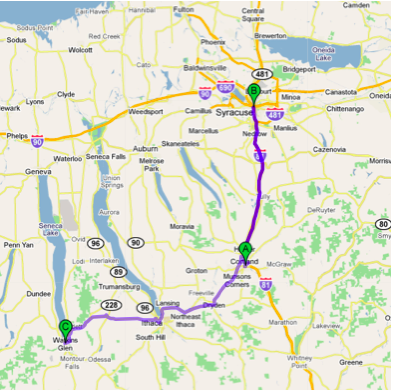
From what I can tell, my readers are academics, vegan foodies and animal rights folks. On a recent three day trip to upstate New York I found a little something fabulous, inspiring, heart-lifting and totally amazingly awesome for all of you! I am considering packing my bags and bearing the cold so that I can have these amazing places in my life.
For the academics.
SUNY Cortland, Cortland, NY
This university rocks because it is progressive. In an age when academic repression is dominant, where people lose committee positions, are denied promotion, have their research rerouted and even get hauled into jail for protecting the anonymity of research participants, there is SUNY Cortland. They housed two progressive conferences this weekend: The Anarchist Studies Initiative and the Institute for Critical Animal Studies. This is a very small town and it felt a bit sleepy at times. However, the scholarship is enough to get anyone riled up.
For the foodie.
Strong Hearts Café, Syracuse, NY
Happiness and comfort entered my day by way of my belly last week when I visited Strong Hearts Café. This place is g-o-o-d. There is a chill vibe, nice staff, sweet environment, comfy tables and a kick-ass menu. And let me reiterate that the food was stupidly delicious. We ate and ate and ate and passed plates around the table. Everything I had there was good: fake egg breakfast muffin, Caesar salad, seitan sandwich, grilled Daiya-cheese sandwich, soy shake, peanut butter-chocolate “cheese” cake, berry muffin, Tofurkey sandwich. ALL of it was delicious!!!! Not to mention, FIVE of us ate for about $40. (That was until we got a round of desserts and “milk” shakes). It was so good I went back the next day. This time I arrived with only my work to keep me company. They happily let me sit and surf the internet while I binged and sipped French pressed coffee. And then they let me hang out and work after I was done with my meal.
I must also mention that the staff was awesome. Everyone wore their own gear and there were animal rights shirts galore. My heart was thump-thump-thumping in this place. I am officially in lust with the ambiance, staff and food at Strong Hearts café. If only I didn’t live thousands of miles away…
For the animal rights person (and anyone who wonders why animal rights people feel the way they do).
Farm Sanctuary, Watkins Glen, NY
Farm Sanctuary was one of the most amazing places I have ever been. (It ties with Animal Acres!) It is a place where animals who have suffered the horrors of factory farms, slaughter houses, hoarders, live food markets and other atrocities at the hands of humans find refuge. These lucky few get to live out their lives in peace with daily access to large pastures, dust baths, ponds and humans eager to serve them. They are given a new life here that allows them the social environments and space they deserve. And I think humans benefit a lot from getting to meet them. At least I have.
It is shocking to see the ways that these animals were once abused and mutilated so that the American population could have cheap food: missing beaks, severed talons, broken horns, weak joints, missing feathers, blindness and scars. Some animals bear the psychological scars of their suffering, while others accept humans into their space and allowed us to give belly rubs, chin scratches and hugs.

Where ever you live, find a farm sanctuary nearby and learn from the amazing experience.
Meeting animals that survived torture and were shy around humans reminded me of our species’ selfish sins. I also met animals that survived torture and were able to forgive humans enough to accept us as visitors in their home. These animals accepted us as individuals and accepted that we wanted to learn from them and not hurt them, even though other humans had injured them greatly in the past. If, like these animals that I met at Farm Sanctuary, humans could also recognize that each non-human animal was an individual, I do not think the situation for animals in our society would be so atrocious.
The animals at Farm Sanctuary are home. They are not at a petting zoo. The animals that didn’t want to be near us didn’t have to be. If an animal was “dangerous” to humans, s/he wasn’t removed, we simply didn’t visit. It is their home. We were visitors. That seems so just. But the fact that this situation is so abnormal seems ridiculously unjust.
log off and get out!
I had the privilege of attending the Utah Valley University Animal Ethics Conference last week. A topic that came up in these conversations several times was the role of Facebook in activism. While Facebook and other social media is good for disseminating information, a prevailing notion was that perhaps it deterred some activism as the time spent chatting and reading others posts could be spent fighting for the animals.
Facebook can be both a blessing and a curse. In the words of one activist, known on Facebook as John Brown:
The dual aspect of FB is clear. It has an amazing capacity for subversive organizing; the creation of a greater union of activists; and the world-wide sharing of information…However, its pacifying aspect is also apparent. One becomes lost in the labyrinth of petitions, meetups, and friend requests. Time ticks by. Hours pass. And nothing substantial has happened. Virtual ‘activism’ replaces actual activism. FB should be used as a tool for organization and mobilization, not decadent stupification.
– “John Brown”
The conference concluded with a wonderful but sobering conversation between the audience members and a powerhouse panel of some prominent defenders of effective activism: Steven Best, Jerry Vlasak and Peter Young. All three of them pondered the role of online activism:
What is it about today’s culture that allows people to pass off their activism as spending 8 hours a day on Facebook and handing out Facebook petitions? And how do we reach people who are interested in helping animals? And how do we get them to realize the revolution is not going to be on Facebook?
–Jerry Vlasak
Why is it that today, in 2010 we probably have so many more people who “care” about the issue but there is so much less being done? We have to ask ourselves, what’s pacifying us? What are these things that come to us as saviors…but are actually pacifiers instead? I would say the internet is one of those things. This has to be one of the greatest myths of the modern day, that the more information you have the more that gets done.
-Peter Young
Steven Best suggested a three day moratorium on Facebook. I think it is a brilliant idea and I am ready to act on it. Are you??
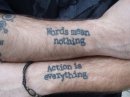
As Dylan Powell from the Vegan Police is fond of saying “Talk – Action = Nothing”
As the tattoo’s on Greg Kelly’s arms say “Words mean nothing. Action is everything.”
So let’s stop socializing and let’s get busy!
I am inspired by their words and hope to use social media to advance a campaign in which we ditch social media for a week and devote that time to the animals. World Week for Laboratory Animal Liberation is almost here. I propose that we spend this week or next figuring out how much time we spend each day online. Then, let’s take 3 days during Laboratory Week for Animal Liberation to devote this amount of time to the animals (or any other social justice movement in which you are involved).
Let’s use Facebook for it’s good for and promote this event! Please see the Facebook invitation and invite others!!!
the d word

I hate the word douchebag. I hate it, I hate it, I hate it. Yet, somehow, no one else seems to. Even the feminist and the animal rights crowds, my typical comrades in matters of language, have embraced douchebag with gusto.
According to Urban Dictionary, a douchebag is “Someone who has surpassed the levels of jerk and asshole, however not yet reached fucker or motherfucker. Not to be confuzed [sic] with douche.”
I followed the link to douche and I can see why the definitions might be confused, as douche is “a word to describe an individual who has shown themself [sic] to be very brainless in one way or another, thus comparing them to the cleansing product for vaginas.”
At least the definition of “douche” gets to the heart of the matter, and ties the now-common colloquialism douchebag to the female “hygiene”[1] product. Using douchebag as an insult solidifies the idea that that which is tied to the vagina is gross and undesirable. (Apparently, the vagina is so ick, that even the products used to “clean” it register somewhere in between “asshole” and “motherfucker.”)
I have rarely had people accept my anti-douchebag claim outright. Typically, I get one or all of the following: you are too sensitive, it’s just a word; douche is bad for women, so it is appropriate to use it as a derogatory term; and, what phrase would you use to replace it?
It’s not just a word…
No word is ever just a word. Language is one of the most important tools we have. Language can liberate and language can oppress. The oppressive force of language is easily observed via the power of the pronoun. Pronouns are often neglected in language when referring to non-human animals, which serves to erase the individual identities of animals. Rather than acknowledging animals as individuals, as “he’s” and “she’s”, individuality is erased by calling each individual only by his or her species name. Another way in which pronouns are used to deny that non-human animals are individuals, is by referring to all of one species as a single gender. For example, people often unreflexively refer to all cats as female and all dogs as male, even when they know an individual cat’s or dog’s sex. Similarly, pronouns are misused to enforce transphobic systems of domination. Transphobia is often expressed when a person refuses to address a transsexual or transgender person by his or her current sex or gender, respectively.
Language also creates and reinforces racism, sexism, homophobia, ageism and all of the other isms you can think of. Let’s look at the history of how American society has “othered” black people through language. As a society, broadly, “we” have never been chosen to just call black people, “people.” Rather, there has been some other word that eradicates personhood altogether (what we now call “the n word,” and “negro”) or a pronoun is used to denote difference (“colored,” “African American,” and “Black”). I am not suggesting a post-racial society, but I am highlighting one way in which words have been used to reinforce systems of domination. To put this last example in another way, there is no other word for “white person” (at least not a widely used term) and the adjective “white” is rarely used when referring to a white person. Often, when I describe myself to others for first time meetings, I say that I am a “white woman,” but I am guessing if I just said “woman” the white part would be implied. In American culture, language works so that white people have the privilege of not being named. Everyone else gets an adjective. In the words of Michael Kimmel,
“Privilege is invisible.”[2]
I can go on and on about how language oppresses. My point is that language matters. A lot. Douchebag is a derogatory term and a douche bag, literally, is associated with women’s genitalia. I know, you don’t think of that when you say it. But that is my point. You should think of it. We let the degradation of women pass, uncritically, into our language; so much so that a term like douchebag has become a colloquialism.
Douchebag is not a feminist phrase
This brings me to the second retort I so often hear in response to my pleas against the d-word: If douche is bad for women, douchebag is appropriately feminist as a derogatory term. Yes, douche is a tool of female oppression. Douches are intended to cleanse the vaginal canal and eradicate odor, but it turns out that most women’s bodies are very good at regulating this without any help. Using douche can actually create a host of health and odor problems all of its own. Douche is bad. But that is not why people use douchebag as the new “it” phrase. Find me one person who thought: “Douche is a tool of female oppression. In order to highlight this I am going to use the term “douchebag” to refer to those who negatively impact the world, since a douche bag is an instrument which holds the fluid that can negatively impact a woman’s vaginal health.”
I am sure all of the people who have ever brought this up as a justification for using douchebag developed this reasoning after the fact.
Delete, don’t replace
Finally, I hear: But what phrase would you use in its place?
Really? Is it necessary for me to figure out a new, original word that people can use to insult each other in order for my objection to the use of douchebag to be valid? Don’t we already have too many words to degrade, denigrate and disempower others?
[1] I put this in quotes because douche is actually very unhealthy and does not promote health or cleanliness.
[2] Micheal S. Kimmel, (2000), The Gendered Society.
carrie feldman released from jail!
For the first time in a long time there is something to celebrate! Carrie Feldman was released from jail today,  where she was being held for her brave and ethical choice to refuse to testify to at a grand jury hearing.
This is reason to celebrate, but not relax. Scott DeMuth is being charged under the Animal Enterprise Terrorist Act (AETA)—he was brought in by the FBI the very day the statue of limitations was to run out on prosecuting anyone for the 2004 Animal Liberation Front raid of a lab at the University of Iowa. Earlier this week a house of vegan activists in Utah had their home raided by the FBI.
Obviously activists are under attack, but at least tonight Carrie Feldman can go home.
political prisoners you should write today
 Below I highlight some animal liberationists in jail. Unfortunately, this is not an exhaustive list of political prisoners in this country. These people are in prison because they live principled lives. Agree or disagree with whether these folks actually broke a law. Agree or disagree with whether its okay to break a law. Regardless of how you feel, these folks live principled lives for causes that matter. They at least deserve some company during their prison sentences. And if you have some extra cash, send that their way too. They could use it for things in the commissary or to help pay their lawyer fees.
All of these people are political prisoners. Our government has tried to silence them by locking them behind bars—for unusually long sentences in most cases. The government might try to silence them, but don’t leave them in silence. Let your letters keep them company. Or send a book to help pass the time. If you can, and I know you can, pick one prisoner on this list and commit to write to him or her until s/he is out of jail.
Something has gone terrible wrong in this world and in this country. That all these people are behind bars and have such harsh sentences is testament to that. Support them. Write them letters. Send them money. And whatever you do, do not let their fates scare you away from all the work that must be done toward creating a more just world. As a movement we must embrace these prisoners as our inspiration. We must learn from their bravery that some things are worth fighting for, no matter the cost. We must show those that might try to repress us that we will not be silenced.
Here are 6 cases that resulted in many political prisoners. All addresses are at the bottom of the post. (Presented in chronological-ish order)…
MOVE is a group founded by John Africa. They lived in a veg*n commune in Philadelphia and worked to reject racial oppression. They faced years of sever police brutality. In 1978, nine members of the group were imprisoned for the death of a police officer. They all received sentences of 30-100 years for the same murder. That is right; one murder but nine separate sentences for that one murder. The officer was shot during a police raid and evidence suggests none of the MOVE 9 could have done it. There was only ONE bullet, but nine people were sentenced because the judge said that since they decided to live as a family, they would be sentenced as a family. (Apparently choosing to love and support one another and adopt the same last name was threatening to this guy).
To add to all this bullshit, the government dropped a bomb on the MOVE house seven years later; leaving only two survivors. 11 people died that day, including five babies. After suffering so much repression, these people need to know that the world remembers and loves them.
Stop Huntington Animal Cruelty (SHAC) USA is a campaign aimed at Huntington Life Sciences (HLS), a company that is hired to perform experiments on animals. The defendants in this case ran a website with information about the location of homes and offices of executives whose companies did business with HLS, so that activists might go protest and pressure them to cut ties with HLS. This was a very successful campaign and so repression came down hard.
All defendants were tried under the Animal Enterprise Protection Act (AEPA) in 2004 and received sentences of two to six years for running this website, despite a disclaimer that they encouraged only legal protest and despite the fact that no evidence was submitted showing any of them ever participated in or knew in advance of any illegal protest activity.
Two of the defendants, Lauren Gazzola and Keven Kjonaas, are still imprisoned. Four defendants, Jacob Conroy, Darius Fullmer, Josh Harper and Andrew Stepanian, have been released (completely or to halfway houses).
Operation Backfire Prisoners: Jonathan Paul[iii] and Daniel McGowan[iv]
Jonathan and Paul were rounded up with a horde of animal and earth liberation activists (Joseph Dibee, Chelsea Dawn Gerlach, Sarah Kendall Harvey (nee Kendall Tankersley), Daniel McGowan, Stanislas Meyerhoff, Josephine Overaker, Jonathan Paul, Rebecca Rubin, Suzanne Savoie, Justin Solondz, Darren Thurston, Kevin Tubbs, and Briana Waters) in the FBI’s “Operation Backfire.”
Operation Backfire was a targeted assault by the FBI under the Bush administration on animal and earth liberation activists.
Daniel and Jonathan would not implicate the other defendants. Jonathan was “sentenced to 51 months in federal prison for his role in the July 1997 arson of the Cavel West horse slaughterhouse. The slaughterhouse was never rebuilt. Over 500 horses were tortured and slaughtered weekly at Cavel West.” Daniel also refused to snitch and so he was given a longer sentence than co-defendants for his role in several arsons targeting facilities that bolster and enable the abuse of our environment and animals.
Kevin is being prosecuted, ahem, I mean persecuted on “10 felony counts. These felonies are multiple counts of: stalking, conspiracy, conspiracy to stalk, and threatening of a public servant. His bail was set at approximately $460,000. He did not meet bail and is currently awaiting trial and on remand in [jail].”
This young woman is one of my personal heroes. She is 20 years old and currently on 23-hours of solitary confinement every day for…
Refusing to testify at a grand jury hearing.
That’s right, she isn’t even accused of doing anything harmful to anyone. She simply refused to take part in an undemocratic process. She tells us why she is willing to suffer this persecution in her statement to the grand jury.
Grand juries were originally created to prevent arbitrary indictments, but are now used as a tool of the prosecution to gather information. Grand juries undercut basic rights supposedly granted in the Constitution by denying access to counsel and coercing testimony. They are now, and have been for some time, used to investigate and intimidate those who would express dissent.
This is only effective when we are complicit, when we are frightened, when we are divided. Today my voice may waver, as I stand alone in this room. But I know I speak with the voice of every one of my friends, loved ones, and comrades when I say this: We will not be intimidated. We will not cooperate. I have nothing more to say to you.
It is this bravery, it is this principled stand, it is this dedication to doing what is right and just and moral that has resulted in her extreme persecution.
William “BJ” Viehl[vii] and Alex Hall[viii]
These activists were arrested under the Animal Enterprise Terrorist Act (AETA), some of the most repressive legislation of our time, in connection with the liberation of 300 mink from a fur farm in Utah. They are both currently in prison awaiting trial.
 What you can send: Each of the websites linked to for each prisoner will give more details, but here are the general rules: send books and magazines! But you have to send new copies directly from the publisher, Amazon or Barnes & Nobel. Photos and photocopies are also okay to send.
What you can’t send: These letters will be read by others, so don’t ask about details of their cases or tell them stuff you don’t want to anyone else to know. You can’t send stamps or envelopes; prisoners must, generally, purchase these from the commissary (most of the websites linked to have links so you can donate money to this end.) Don’t send anything flamboyant like glitter (yeah, that seems pretty arbitrary to me too) but drawings and maybe even collages are acceptable. No newspaper or magazine clippings (but again, photocopies are okay). Check with each support page for more details.
[i] MOVE 9
One of the 9, Merle Africa, died in 1998
Michael Davis Africa #AM4973
Charles Sims Africa #AM4975
P.O. Box 244
Graterford, PA. 19426-244
William Phillips Africa #AM4984
Delbert Orr Africa #AM4985
1000 Follies Rd.
Dallas, PA. 18612
Edward Goodman Africa #AM4974
301 Morea Rd.
Frackville, PA. 17932
Debbie Sims Africa #006307
Janet Hollaway Africa #006308
Janine Phillips Africa #6309
451 Fullerton Ave.
Cambridge Springs, PA. 16403-1238
Mumia Abu Jamal #AM8335
175 Progress Drive
Waynesberg, PA. 15370
[ii] Lauren Gazzola # 93497-011
FEDERAL Federal Correctional Institution
FCI Danbury
Route #37
Danbury, CT 06811
Kevin Kjonaas #93502-011
Unit I
FCI Sandstone
P.O. Box 1000
Sandstone, MN 55072
[1] Jonathan Paul
[iii] Jonathan Paul
#07167-085
FCI Phoenix
Federal Correctional Institution
37910 N. 45th Ave.
Phoenix, AZ 85086
Friends of Jonathan Paul
PMB 267
2305 Ashland St., Ste. C
Ashland, OR 97520
friendsofjonathanpaul@yahoo.com
[iv] Daniel McGowan
#63794-053
USP Marion – CMU
P.O. Box 1000
Marion, IL 62959
[v] Kevin Olliff #1300931
TTCF 161 C-POD
450 Bauchet St.
Los Angeles, CA 90012
[vi] Carolyn Feldman
770 Iowa St.
Dubuque, IA 52001
[vii] William James Viehl
Inmate # 2009-05735
Davis County Jail
800 West State Street
Farmington, UT 84025
[viii] Alex Jason Hall
Inmate # 2009-06304
Davis County Jail
800 West State Street
Farmington, UT 84025
hope(less)
Hope is definitely not the same thing as optimism. It is not the conviction that something will turn out well, but the certainty that something makes sense, regardless of how it turns out.
A few days ago I saw this horrifying picture on someone’s Facebook page.
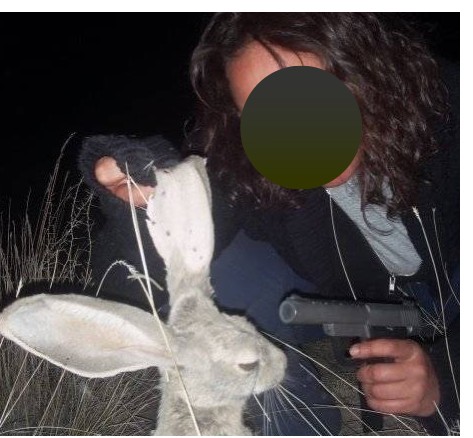
I look at that picture and I see a woman whose sense of fun took the most valuable thing from the world that she could: life. She did this with no justification- other than that she thought it would be fun to shoot an animal. Also disgusting, were the comments posted by her friends:
“Fuckin awesome. Guess his feet were’t to lucky”
“Sweet Jesus, what the hell is that??!!”
“haha!!”
“THAT PHIL IS A VERY DEAD BUNNY”
“That’s the biggest fuckin’ rabbit I’ve ever seen. Kudos to you!”
“ahhhhh! did you seriously kill that thing? His ears are Massive! haha baby stanley is WAY too cute to kill!”
“he is no Stanley !!! he needed to go… lol”
These comments remind me that acts of cruelty and disrespect for life are commonplace and socially acceptable in our culture. Finding hope becomes difficult in the face of this reality. Finding the place inside myself, where I can live in a world in which this picture and the act it captures is actually funny, is a daily struggle. This woman is holding a dead rabbit that did nothing to deserve her fate. I think of that rabbit suddenly, unexpectedly suffering the hot sear of a bullet ripping though her body. If she had time to contemplate what was happening, she must have thought, What? And then, Why?
I can’t imagine the confusion and the pain this rabbit felt. And when I try to imagine it I feel nauseous and angry and confused and lonely and scared. Neither can I imagine what makes someone consider this a fun or funny endeavor. I am horrified. I am confused. I am lost.
I don’t understand why it is that most people choose not to see the things that I see so clearly.
I see animals who are denied all freedom and killed in scary painful ways. I see the eyes of a fox, his skin torn off of his body before he is killed. I see him, crying, whimpering, slowly dying, shocked by the pain. Most people see clothes.
I see concentration camps and torture chambers and kidnapping and environmental degradation and heart disease and cancer. Most people see “meat”.
I see emaciated, hungry cows with broken tails and swollen hooves. I see impoverished people working in tanneries, hands covered in boils, cancers taking over their bodies. Most people see shoes and purses and watchbands and car seats and briefcases and jackets and belts and furniture.
I feel fear and pain and panic when I think of the rabbit in that picture. Presumably, that woman feels fun or accomplishment and doesn’t acknowledge how cruel and brutal she has been.
A world with so much violence and selfishness and horror is not a world I know how to live in. It becomes tempting to give up all hope. And some days I do. But it is the hopeless days when absolutely nothing gets done. So today, like every day, I will try to muster up all the hope I have. I will hope that if I keep trying and pushing and working for what I know is right something will change. I am not optimistic, but I am hopeful.
top six podcasts that make me say :D

Best. News Program. Ever. Awesome interviews, great topics, and no selling-out. Thank you, Amy Goodman, for keeping it real!
Who wouldn’t love a podcast that begins like this:
“Peace. Now. Go vegan. Peace. How? Go vegan. From the left coast to the genetically mutated McNugget pharmacutakill vivisection prison killatary industrial court port nation in the cheese-covered, post-constitutional, bankrupt, bribeacratic, mockracy, corruptacracy, criminocracy of the United Stakes of Lustaria, this is Go Vegan with Bob Linden…”
When I am in need of new music I stream an episode of this show. Jason Bently definitely keeps it eclectic and a new artist/group (with interviews!) is featured on every show.
This gist: all presenters are recorded live, onstage, in front of an audience. The rules: no notes allowed, true stories only. This is very hit or miss. It may be great, or it may suck, but they are usually only 10-15 minutes long so you’re never at a loss and you may be wonderfully pleased.
Every week brings a new topic and a few stories about that topic. Ira Glass hosts. You’ll either love his voice or hate it. I love it (grrrowll…). This is one of my all time favorite listening experiences ever. Whenever I need to find comfort and calm inside my head, I listen to this podcast and bake. This ritual centers me every time. But for those of you with more normal centering techniques, it is also great to listen to on road trips or before bed in lieu of a book.
Currently with 38 episodes available for streaming, Christa, Dylan and Ryan have a tight site and sweet podcasts. (I think I already made that clear!) They find all the cool vegans and all the cool topics.
What’s your favorite podcast?
does your vagina say “bling”?
Every time I shower the landscape of my pubic hair becomes a political battlefield.
Shave?
Don’t shave?
Trim?
Soap or Shampoo?
(That last one was a joke, but it is actually something to consider, I guess…)
It seems an easy enough decision, but one that has been a problem for me since the first hair. Not only do I struggle over the issue in the shower but my pubic hair has been the focus of a least one major “conversation” in every serious relationship I have been in in my adult life. More often than not, I have been accused of not having “feminist enough” tendrils “down there.” My response has been that feminist pubic hair is styled in any way one chooses. But in truth (and perhaps why I become so defensive on the topic), I don’t know what style I truly consider pubes-chic.
I’ve gone through every possible iteration of shaving (and waxing and trimming). I’ve also gone through every style of not shaving or waxing or trimming. I’ve never quite figured out what I actually like, because I am too busy worrying if my preferences are dictated by the voices of dominant culture, the voices of the men I’ve dated, the voices of my feminist mentors or the voices in my heart.
If I go for a landing strip and feel sexy, I wonder if I just like it because porn culture invaded my brain. When I grow a full bushy mess and it makes me feel powerful, I wonder if I am erroneously raising my pubic tendrils to symbolic stature because I was told I should feel that way by all those smart women in all those kick ass books I read in college.
But finally, I have found one pubic trend about which I know how I feel:
That’s right—bedazzling for the vagina. Just the sort of trend a lady born in the 80’s might go for. But, no! Not this girl, not this time and not this trend!
Jill broke the story to me on Feministe (though apparently Jennifer Love Hewitt discussed this on the Goerge Lopez show and got the blogosphere going wild over this new trend weeks ago). I think Jill said it best:
I can’t even begin to imagine the ingrown hair situation there (or the totally disturbed look you’ll get when your dude or lady comes face-to-face, if you will, with your Swarovskified-vulva), but to each their own.
I think vajazzling sums up pretty much everything that sucks about consumer culture and the objectification and fetishization of women’s bodies. Vajazzling involves women feeling like they need to change some part of their body and this change requires them to spend lots and lots of money on a regular basis.
I can take my vagina bushy or bald, but I don’t think I could live with my vagina if it was all bling…

 Vegina